Showing posts with label rescue. Show all posts

Thursday, April 26, 2012

A Tale of Two Opossums


Being a licensed wildlife rehabilitator makes you look at your surroundings in a different way than most people. When my husband and I drive anywhere, one of the things we are always looking for is good patches of dandelion greens to pick for the many cottontails we rehabilitate each year and the other being any injured animals that may need our help. One animal specifically we notice are any dead opossums because anyone of them could be a mom with babies still alive in her pouch. As the only marsupial in North America, mom opossums carry their young with them in their pouch for a number of weeks. They can have two sets of babies each season, one in spring and one in fall. That is why between April and October it is so important to check any dead opossums you see on the road (where it is safe to stop and check).

So the story goes that we are always on the lookout. On September 11th we found a great patch of dandelion greens in Ottawa. The following Tuesday morning my husband went back there for more greens and saw a squashed mamma opossum (he could tell because there were scattered dead little ones on the road). To keep anyone who would be grateful for the free meal from being in the way of traffic, he dragged her way off the road and started picking greens. After just a little while he started thinking; he’d seen her dead and all the little ones but didn't actually check her pouch. So, back he went to where he had dragged her and sure enough - one little guy was still hanging on - ice cold but alive. He brought him home, weighed him and tucked him into a box on heat to warm up.


That night, I had promised to release some orphaned cottontails in a friend’s yard in the town of Waukesha, so after work we packed them up and hurried over there. All went well with the release, but now it was almost 7pm, getting dark, and we need greens again for overnight and morning for the bunnies that were still at home. We wondered where to go - look around and waste time, or go back to Ottawa, which takes time to drive to, but where we’d be assured of abundant greens. We decided Ottawa was the best choice, so off we went. I started picking down the road one way and him the other. A little later he came over and said he thought he heard something but wasn't sure. I came over by where he was picking and listened but heard nothing. Then, a little sound, and nothing again. We didn't want to walk around for fear of stepping on any little ones, and needless to say, by now it was getting dark and we really had to keep picking greens. So I got down to ground level and started making mamma opossum sounds and my husband got down and began to make baby opossum sounds. Sure enough, in just two seconds we hear another little baby. He'd been out there all that time and was cold as ice, but we found him and as of this writing, he and his brother are doing really well.

So, it just goes to show you, if take the extra time you may be able to help save a life.

Guest Blogger: N.M.


Photos courtesy of M. Draeger.

Wednesday, December 7, 2011

Dakota Returns Home

Dakota has been rescued and is now safely back home. At 7:30AM this morning staff contained the beloved Great Horned Owl whose 3 week ordeal is now over.


At 6AM staff was contacted by the homeowner of a site that has been under surveillance for over a week. Dakota was seen on the rear deck and was still there when staff arrived at 6:30AM.

When approached, Dakota flew off to a tree, flying low to the ground the entire distance. After several more lower, short flights between homes, trees, and fences in the area, he landed on the railing of a nearby home. One of our staff members was able to slowly approach up the stairs and after an excruciatingly long few moments, was able to safely contain him. After successfully securing him for the ride back, Dakota was finally returned home.

He is resting and recuperating after being examined by his veterinarian earlier today. (we are extremely grateful for the hours volunteered by Dakota’s Veterinarian, Dr. Waliszewski and others who assist us with both resident and patient animals all year long) Dakota returned very dehydrated and thin, but has likely been able to find some food to survive. We are still waiting for results from blood tests to determine if he has other health problems that will need to be addressed.

Dakota will be monitored and cared for, including fluids, for the next week before another evaluation will be completed to see if his condition is improving. Obviously, his physical condition as well as his temperament will determine when he will be able to return to programs and resume his position as the Wildlife In Need Center’s ambassador. We are grateful to have Dakota back where he is safe and only he can determine when he will be ready to return to work.

Thank you to everyone for their support and concern over the past several weeks. Keep watching this blog for updates as Dakota's recuperation continues.

Thursday, October 27, 2011

A Tale Of Two Opossums


Being a licensed wildlife rehabilitator makes you look at your surroundings in a different way than most people. When my husband and I drive anywhere, one of the things we are always looking for is good patches of dandelion greens to pick for the many cottontails we rehabilitate each year and the other being any injured animals that may need our help. One animal specifically we notice are any dead opossums because anyone of them could be a mom with babies still alive in her pouch. As the only marsupial in North America, mom opossums carry their young with them in their pouch for a number of weeks. They can have two sets of babies each season, one in spring and one in fall. That is why between April and October it is so important to check any dead opossums you see on the road (where it is safe to stop and check).

So the story goes that we are always on the lookout. On September 11th we found a great patch of dandelion greens in Ottawa. The following Tuesday morning my husband went back there for more greens and saw a squashed mamma opossum (he could tell because there were scattered dead little ones on the road). To keep anyone who would be grateful for the free meal from being in the way of traffic, he dragged her way off the road and started picking greens. After just a little while he started thinking; he’d seen her dead and all the little ones but didn't actually check her pouch. So, back he went to where he had dragged her and sure enough - one little guy was still hanging on - ice cold but alive. He brought him home, weighed him and tucked him into a box on heat to warm up.


That night, I had promised to release some orphaned cottontails in a friend’s yard in the town of Waukesha, so after work we packed them up and hurried over there. All went well with the release, but now it was almost 7pm, getting dark, and we need greens again for overnight and morning for the bunnies that were still at home. We wondered where to go - look around and waste time, or go back to Ottawa, which takes time to drive to, but where we’d be assured of abundant greens. We decided Ottawa was the best choice, so off we went. I started picking down the road one way and him the other. A little later he came over and said he thought he heard something but wasn't sure. I came over by where he was picking and listened but heard nothing. Then, a little sound, and nothing again. We didn't want to walk around for fear of stepping on any little ones, and needless to say, by now it was getting dark and we really had to keep picking greens. So I got down to ground level and started making mamma opossum sounds and my husband got down and began to make baby opossum sounds. Sure enough, in just two seconds we hear another little baby. He'd been out there all that time and was cold as ice, but we found him and as of this writing, he and his brother are doing really well.

So, it just goes to show you, if take the extra time you may be able to help save a life.


Guest Blogger N.M.

Thursday, January 6, 2011

Holiday Mail

It's the end of the year and the support of our current former and future volunteers and members means even more this time of year. Things are always busy even though far fewer patients are coming in each day as we have reports, tax forms and myriad other office duties to finalize. Not to mention all the planning for the next season! I know that everyone of our readers was here yesterday looking for our most recent post and didn't find it. Lisa wrote a wonderful post to share with you all though and I know once you read it you'll realize it was worth the wait. 

Mail at the Center around the holidays is fun. We get more mail than usual, especially this year because in addition to our annual year-end appeal we have launched our capital campaign as well. But it’s the holiday mail that is so exciting to open. Beautiful Christmas cards with wildlife pictures spill from envelopes. Former and current volunteers send letters updating us on their families’ activities in the past year. Many of our former volunteers have retired to warmer climates (if only I could follow!) and volunteer with other wildlife rehabilitation facilities so it’s interesting to hear their stories. We even get picture cards of families - and their pets! I’ve been here awhile so I remember many of these people and it’s always great to find out what they are up to now. It brings back memories from the past – remember that rescue when…, that bird that got loose on you in the clinic and then…, the phone call when the people said they had a kangaroo in the yard (it wasn’t a kangaroo, it was a wallaby). The stories when you mix people and animals are always interesting and often take some odd turns. The memories are wonderful to recall.

Some cards come with donations that are holiday gifts to family and friends. Some are memorials. Since 2003 we have gotten a memorial in December for Courtney, daughter and sister. I don’t know Courtney’s story, but each year I think of her and her family. One of our volunteers started her volunteer work here as a memorial to her daughter who had been an intern with WINC and passed away around the holidays several years ago. She says volunteering here makes her feel closer to her daughter. For several years in December we’ve received a donation from a kind woman who asks that we send our newsletter to her nephew who is incarcerated. I remember her initial letter. She didn’t make excuses for him but lamented his poor choices that led to his situation. She said he was someone who always has loved animals and now he can’t be around them and so she thought our newsletter would be of interest to him. As someone who has always had pets and works with wild animals to help them be free and wild again, I can’t imagine not being around animals and not being free myself. I wish her nephew rehabilitation and freedom in the future. These sad notes make me grateful for my life and the people in it. This is a good time of year to contemplate the many gifts we all have in our lives.

We get Christmas cards and notes from our members and from people who have brought us wildlife thanking us for caring for the animals. It’s what we do every day and so most of the time I don’t think of wildlife rehabilitation as something out of the ordinary. Doesn’t everyone drop bill paying to go rescue a Great Horned owl lying in the road? Don’t all of you discuss juvenile raccoon fecal results while eating lunch? Answering phones while wearing Slither the Educational Fox Snake isn’t out of the ordinary to me. Driving to the vet’s office with a screech owl, a painted turtle, a mallard and a red-tailed hawk isn’t the beginning of a joke but just ordinary car-pooling, isn’t it? Listening to the rustle within boxes as our UPS guy brings this weeks delivery of 80,000 live mini mealworms, 40,000 live medium mealworms and 2,000 live wax worms just reminds me that I need to order more frozen mice and chicks too. Visiting the restroom and sharing space with the Canada goose in the tub happens at your house too, right? But I really appreciate the kind words and thanks of people for the work we do. Staff and volunteers make a difference to animals every day here and it is a special privilege to do so. Sometimes I just have to stop and enjoy the sight of our wild patients or Dakota the educational great horn owl hooting hello as I go from the office to the clinic and be thankful. WINC is a special place filled with wonderful caring people and amazing animals. It is a gift to be here every day of the year.


Guest Blogger L.R.

P.S. We still have fabulous 2011 WINC Calendars featuring our educational animal ambassador team! They are only $15 and all the funds raised go towards our care for wild neighbors.
For more information on how to get one visit or contact our office

Wednesday, December 8, 2010

Rescues Gone Awry Part III

Did you enjoy the antics and harrowing efforts relayed by Lisa in previous posts? If so, you're in for another treat!

Summer Sun

Anyone who knows me knows that woodchucks have a special place in my heart. I am always stopping to check animals by the road to see if it’s still alive, and if dead, is it a nursing mother in season. If so, I have spent days walking the area and looking for the burrow to try to capture the nursing babies who would otherwise starve. One summer morning stopped at a stop sign on my way to work, I looked across the intersection to see a woodchuck lying flattened in the road. I drove across to see if the woodchuck was still alive and to check to see if it was a nursing female whose babies I should try to find. I parked on the shoulder and walked to the woodchuck who was about two inches thick on the road. As I got within about five feet of it, it looked up at me, glared, and scampered off to the tall grass on the side of the road. It was a cool morning and the woodchuck was lying on the black pavement sunbathing! Woodchucks can get amazingly flat and they do like to sunbath on cool days, soaking up summer heat. This one was absorbing heat from the pavement as well as from the sunlight. But it certainly wasn’t doing so in a safe location so I don’t regret interrupting its morning ablutions.

Frosty feathers

The caller said that a goose was frozen into the new ice on a local lake. We often get calls like this with our first freezes of the year. I have not yet had an actual case of waterfowl being frozen into the lake. The waterfowl will float on the water with their feet tucked up in their warm downy feathers. When the water freezes a few feathers may be caught in the ice, but the ice freezes slowly and the bird is warm so they don’t get actually frozen into the ice to the point where the animal is trapped. The first freezes are so tin that the bird can easily pull loose. Later the ice is thick enough that the birds lay on top of the ice. I cautioned the caller against going onto the ice as it would not be safe for a persons weight, but suggested they try skipping some small stones or sticks towards to bird to see if they could get the bird to move to prove to them it wasn’t stuck. I once used a remote controlled toy truck to drive onto ice to scare some domestic geese into moving on ice to chase them to shore. The person called back later to sheepishly admit that on closer inspection the goose was a decoy. I thanked them anyway for their concern for an animal they felt was in need of help.

A number of waterfowl will choose to brave our Wisconsin winters if they have access to regularly open water and a food source
Is that a Bird?

Sometimes people need help that is more than we can provide. A few years ago someone called to report large black birds that were carrying people away in Waukesha. Our office person asked questions to make sure this was not a prank. She then tried to reassure the caller that in Wisconsin we do not have birds large enough to carry full grown adults away. But the caller insisted that these giant birds were actually picking up adult people and flying away with them. They had seen this happen with their own eyes. No amount of discussion would dissuade the person. In that case we suggested to the caller that this was a situation we were not equipped to handle and asked for their name and contact information. We asked them to call the police to report this situation and gave them the non-emergency number. We also called the non-emergency police number to describe the phone call and ask that the police do a welfare check on this person as there appeared to be a problem with reality. The police didn’t call back to let us know what happened of course. But I did watch the news the next few days and did not hear of the rediscovery of extinct pterodactyls in Waukesha so feel we assessed the situation correctly.

Guest Blogger LR

Thursday, November 11, 2010

A Harrowing Rescue Tail

Back in June of this year strong tornados came through southern Wisconsin taking down power lines and causing damage to homes of both people and animals alike. In the days after the storms had passed, one call we received was a caring woman who had a young a bald eagle that she thought was in need of help. Here at the Wildlife In Need Center we generally rely on the public to bring us injured, sick or orphaned wildlife but in some situations we are able to send trained volunteers or staff out on rescues. In this instance, Rick, a dedicated volunteer was able to help. After a long drive winding through the aftermath of the storms and avoiding all of the turtles that had found their way onto the road, Rick finally arrived at the start of his journey.

When Rick arrived at the home of the caller she showed him there they eagle was; perched in a very large tree over a ravine filled with other trees and vines covering the ground. Things were about to get difficult. The branch that the eagle was on was at the same level as the top of the ravine but too far away to simply reach out to. Rick attempted to use a net that was attached to a pole. It was just long enough to reach the bird but it kept getting tangled in the tree. At this point Rick had assessed the bird from a distance and realized that it was a younger bird and that it was pretty emaciated and most likely dehydrated. Because the bird was young, it's likely it was still unskilled in hunting and may have become too weak to fly well. This can be dangerous even though there weren't any substantial injuries because being too weak to fly means that he wouldn't be able to hunt which is how he became weaker to begin with. Rick succeeded in nudging the bird out of the tree and it glided to the ravine floor.

Rick followed the bird into the ravine full of tangled vines. He crept closer and closer to the eagle and just when he had it in his sights, the bird hopped away. This struggle continued across the ravine for about an hour, but even while tripping on and getting tangled in the vines with every move, Rick was not about to give up. He asked for help and even though the woman who called was not able to herself, she found other caring neighbors that could. The new recruits formed a human wall behind the bird to keep it from escaping onto the clearing and Rick moved in again. This time he successfully captured the eagle in a large blanket.

The bald eagle was, as Rick predicted, emaciated, dehydrated and very underweight. After spending just a night at WINC it was transferred to a rehabber at Pineview for expert care in a facility with more resources for the size and care required for this type of bird. After such a difficult rescue Rick wanted to make sure the eagle did well and asked to be kept informed on its rehabilitation progress. After the eagle had been returned to health Rick received another call, but this time it was to be there for the release back into the wild of the eagle he worked so hard to rescue.

Without teamwork this eagle’s story may not have had such a happy ending. Teamwork between staff, volunteers and the public is key in the success of both rescuing and rehabilitating an animal. If this caring woman had not made the call we would have never known there was an eagle in need of our help. Without dedicated volunteers or the other caring individuals who offered assistance, the eagle may not have been able to get the help it needed and this hard to top rescue may not have been such a success.

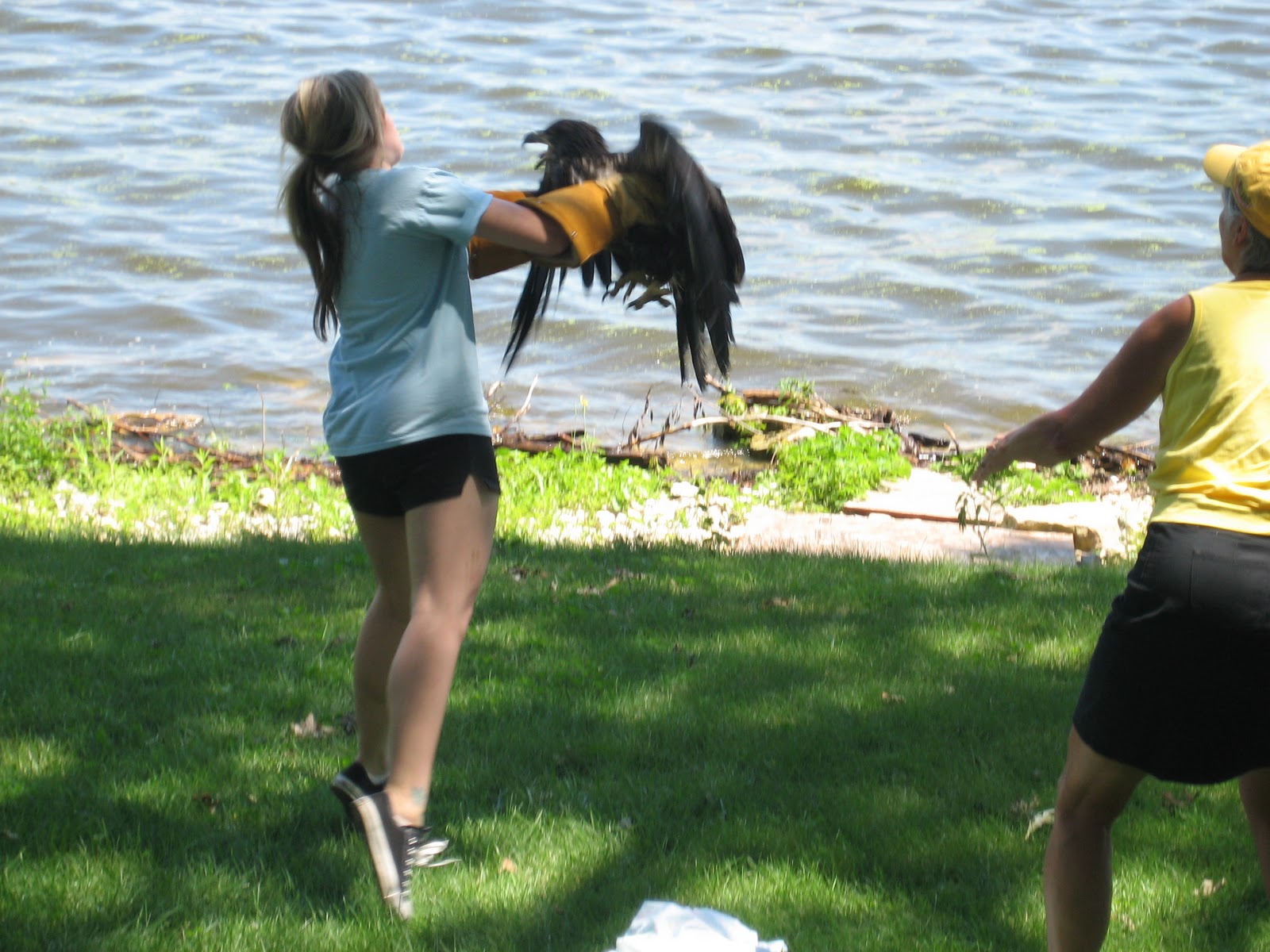
Rehabbers from the Center the Eagle was transferred to and cared for at release it back to its home territory while Rick photographed the moment he had been hoping to see since he first rescued the bird.

Wednesday, October 20, 2010

Canadian Geese in Wisconsin Falls

No, I don’t mean the Dells. Whether you like them or not, Canada Geese are a big part of the fall landscape in southeastern Wisconsin. Large flocks descend on recently harvested corn fields and area lakes and streams. This is also the time of year when caring people will start to notice those unfortunate souls who get left behind.

Just today I answered a half dozen calls each regarding a different goose in similar situations. Our mission to rehabilitate any wild animal native to Wisconsin remains the same regardless of the time of year, but the calls and patients we get in the fall, especially the latter part of the season are some of the most difficult for both the animals as well as the people involved.

Of course each situation is different, but many have the same obstacles to overcome:

  • The goose spends most of its time on water where it is difficult or impossible for a human (or any other predator) to catch him
  • The goose can still run even when she does come out of the water making it easier for her to duck, dive and hide in the bushes where she’s safe from predators (us)
The other reason many of the calls we receive about geese this time of year are difficult is that injuries sustained a few weeks (in some cases even a few months) ago are unlikely to be repairable. If an injury is severe enough to keep a bird from doing what comes natural to it, namely flying, and it goes unnoticed and untreated for too long, the chance that we will be able to re-set it and convince it to heal properly is small. Due to regulations and the inability to survive if done so, we cannot generally just amputate the injured area. Even if we could, the animals overall health is often not good enough to ensure their survival through the process or follow-up care.

If you see a goose, duck or other type of waterfowl that you think needs help please gather the following information before contacting your nearest rehabilitator.

  • Where has the animal been seen most often and how near is it to water
  • What behaviors (holding out or dragging one wing, noticeably limping, unable to balance) are you witnessing that could help us pinpoint the injury
  • How close has a person walking been able to get to the animal before it responds (ie. tries to run away, dives into the water, or perhaps it can’t move at all)
With geese that aren’t yet approachable but are obviously injured the best situation would be for someone frequenting the area to offer up small tidbits of food like cracked corn, rolled oats or bird seed. This lulls the animal into a sense of security and will hopefully give that individual or one of our volunteers a better chance at getting close enough to contain the animal when it is up and away from the water's edge.
If you have any questions about an animal you think needs help always contact your local rehabilitator for advice and guidance.

Wednesday, October 13, 2010

Rescues Gone Awry Continued

Those of you who are regular readers may recall last week's harrowing tales of rescues gone awry. After being dedicated to the cause for as many years as Lisa’s been, she had lots of stories to share so I wanted to offer a few more.

Turtle Crossing

Driving down Highway 94 west during the summer, I saw a flash of what appeared to be a turtle on the side of the road. A dark olive, almost black color body with a bright yellow throat - Oh no! – a Threatened species, a Blanding’s turtle. By the time I realized what I had seen at 65 miles an hour, I was well past it and had to go to the next exit, take 94 east, exit and go back west. I saw the turtle ahead still on the shoulder, not in the road, thank goodness. I pulled over and jumped out to grab the turtle before it was hit by a car. It was an olive colored canteen with a bright yellow lid, which was popped open, pointing upward. I rescued it anyway. Another time during the summer when turtles were crossing the roads to lay eggs, I was driving and saw a turtle laying on the road. I stopped to rescue it, but it was a piece of car tire. I have also stopped to rescue several snakes that turned out to be car engine belts.

Blandings turtles may be endangered, but nearly all of the reptiles and amphibians native to Wisconsin are experiencing population declines due to loss of habitat and interactions with people (and our vehicles)

Seeing isn’t always believing

Driving to work one morning east on Highway 94, I saw a red-tailed hawk sitting on the west 94 shoulder. Probably hit by a vehicle, it was sitting injured or stunned on the shoulder. I exited east 94, went back west bound. I scanned the shoulders as I drove but did not see any hawk on the shoulder on either side of the road. Maybe it was just stunned and flew away, maybe it was eating roadkill on the shoulder and flew away. I exited west 94 and returned to east 94 to head back to work. As I approached the same spot, the red-tail was back on the shoulder. I looked more carefully at the location, marking landmarks in my mind so I could more accurately pinpoint where the hawk was. Exit east 94, back on west 94. As I approached the spot, I pulled off on the shoulder and put my flashers on. No hawk on the shoulders. Looking further, I spotted the red-tailed hawk sitting on top of a fence post in the far ditch. I walked towards it and it flew off, giving me a haughty stare. From east 94, I could not see the fencepost in the ditch; the optical illusion was that the hawk was standing on the shoulder of the raised highway. So, laughing at myself, but glad the hawk wasn’t hurt, I drove off west 94 once again and head back on east 94 to work.

Our educational Red-tailed Hawk, Raenah, was a victim of a vehicle strike

Guest Blogger LR

Thursday, October 7, 2010

Rescue Mishaps: Not what you'd expect

I’ve done many rescues for the Wildlife In Need Center over the years and most go well, a few crazily wrong, but some turn out altogether not to be quite what they seem. Now that we’re coming to the end of the busy season I thought I would relate some of these adventures.

Decoys gone wild

Driving down Highway 18 east of Wales, on the way to Brandybrook Community Center for a fall volunteer meeting a few years ago, my eye was caught by a white owl sitting on a fence post in a field. Unless it was a rare albino, the only owl we ever see in Wisconsin that is white is a Snowy Owl. We do not normally have Snowy Owl in Wisconsin as they live in the Arctic. But sometimes in winter when there is a cyclical crash in their lemming food populations, Snowy Owls will come further south looking for food. I wanted a closer look to see what that owl was. I turned around, drove back and stopped my car before I got the owl. The owl’s back was facing me and across the ditch and field I could see barbed wire twined around the post and the owls feet appeared to be tangled in the wire. I quietly got out of my car (owls can hear a mouse the distance of a football field so I’m sure it wasn’t quiet to the owl), put on my leather handling gloves and grabbed a towel. I knew I would have to subdue the owl quickly because I did not want it to thrash its feet and shred them on the barbed wire. I crept up behind the owl and was almost ready to throw my towel over it when I stopped. The owl was a plastic Great Horned Owl decoy that was so weathered the paint had worn off leaving the white plastic showing through. The barbed wire was holding it to the post. Obviously it had been there for years and I had driven past many times never noticing it. Some wildlife professional I was to mistake a decoy for a real owl! When I arrived at Brandybrook I related my story to explain my lateness. When I told people that I had stopped for a white owl on a fence post, several said “It’s a decoy!” Apparently I was not the only one fooled by a decoy.

Flightless in the rain

A call came to WINC during a driving rainstorm. Someone had called someone else to report seeing a hawk hit by a car south of Waukesha on Highway 59 between Highway 164 and Highway XX. Because I didn’t talk to the witness I didn’t have an exact location. But I did have extra coverage in the office so off I went to see if I could find the hawk. I drove east on 59 looking on both sides of the road for a hawk in the rain. Then I saw a crumpled mottled gray form laying against the fast lane curb on west-bound 59. I drove to the next intersection, turned around and drove back. I parked on the shoulder, grabbed my gloves and towel, and waited in the pouring rain to dash across two lanes of traffic to grab – a dirty gray t-shirt, filthy from being run over, probably thrown by momentum of a vehicle against the curb in a vaguely hawk-like shape. I did rescue it so no one else would mistake it for an animal. I didn’t know if that is what the person saw or if they had actually seen a real animal hit, so I drove back and forth that section of road four times before heading back to WINC to dry out. Hopefully our hawk friend wasn’t injured and flew off to find someplace dry as well.

Volunteers at last year's basic rescue training class.


During last year's basic rescue training class volunteers wrangle our educational muscovy duck for practice.

-Guest Blogger LR