Friday, December 30, 2011
The indoor aviary Dakota was moved to is a new feature of our new building; it can hold temperatures independently of the rest of the building. This will allow us to very slowly decrease the temperature of the room to get Dakota to adjust to the outside winter temperature before actually moving him outside. This will be a slow process, but we are thrilled about the big steps Dakota continues to take forward!
Sunday, December 18, 2011
What is a pellet?
| Dakota began casting pellets (complete ones) only two days after beginning solid foods (the first note looks like it says 2/15/11 but it actually is 12/15/11) |
| On Sunday, December 18th, Dakota cast his 4th pellet! This is holiday cheer for those who work with wildlife! |
| This display was made for WINC to use for display and educational purposes. It shows examples of some of the things you might find if you were to dissect a typical pellet |
Saturday, December 3, 2011
Increasing Dakota Awareness & Education
This has been a very busy week for us at WINC, due in large part to our efforts to continue to reach out to the community and increase awareness of Dakota’s situation. We know our efforts are working, because we have been contacted by so many new people who have reached out to us: people who have just started following our blog & our facebook page, people who have now seen our flyers and heard about our search locally, and people who are becoming aware of Dakota from news stories and the internet. It is an amazing thing to see, just how many people have been touched by Dakota’s plight, and the awesome distances his story has traveled. We have been getting calls from as far away as Canada, from people who want to share information with us & help us in any way they are able, and to contribute ideas to our efforts to see Dakota home once again. It cannot be overstated how heartened we are for the continued well wishes and positive support we receive. If there has been any upside to this sad situation, it has been the constant stream of caring we have been blessed with. We are humbled by the generosity of spirit the community has for Dakota, and overwhelmed by how he continues to educate, even during this current situation.
As a part of our education and outreach efforts, we would like to remind everyone that during this difficult time for WINC, one of the things that is of the utmost importance to us is that we return the respect we have received. We are ever mindful that we want our impact on the community to be a positive one, and ever mindful that the example we set in our search methods allows us to achieve maximum impact with a minimum “footprint”. We are striving to be very respectful of the people who live in the neighborhoods we are searching in, and are therefore keeping our search parties small and quiet in nature. We are so very grateful for the opportunities we have been given to search on private property with permission, and wish to publicly thank everyone who has so graciously allowed us to continue searching on their land. We are also grateful that everyone who has offered to help us search has continued to contact WINC before acting alone, and has allowed us to take the lead on any organized searches. This in turn has allowed us to conduct ongoing searches with minimal disturbance to the community, and maximum respect to it. No search parties organized by WINC will ever venture onto private property wihout permission.
We are also mindful of the impact our searches have on the environment, and mindful that we continue to fulfill our core mission of helping wildlife in need, and not creating any in the process by disturbing the existing balance. We have been very careful not to create nuisances, both by being selective of where we place our feeding stations, and not disturbing the patterns of existing wildlife in any of the areas we are searching. Above all else, we would never want our efforts in our search for Dakota to bring any harm to the existing wildlife in the areas we are searching. We take extreme care not to harass any wildlife in those areas, and to be respectful of their habitats & not disturb them. Again, we want to thank everyone who has chosen to help us to watch out for Dakota for the care they have also taken and continue to take, to always be respectful of the wildlife that lives in those areas. Though we have stated it in our poster, it bears repeating: if you spot a Great Horned Owl that you believe to be Dakota, please, please, PLEASE do not approach him or call to him. Please watch him closely while being extremely quiet, and contact the Wildlife In Need Center immediately. Dakota will respond to his handlers, and may be frightened by people he does not already know and is comfortable with. We would not want anyone to inadvertantly further traumatize Dakota, or unduly traumatize any other owl(s) in the area who might be mistaken for Dakota.
During this past week we have continued to hand out informational flyers during our daily foot searchs, and have followed up on many leads from people who have reported hearing owls in their area. Unfortunately, we still have not been successful in pinpointing Dakota's exact location. We have heard owl calls from time to time, but not always received responses that we could definitively identify as Dakota’s. We have made some minor changes to the locations of the feeding stations, but still have not seen any measurable evidence that he is visiting them. Even though it may seem obvious, one of the things that people sometimes forget is that, even if he is not catching live prey, Dakota will eat dead animals. And even if he is not visiting the feeding stations to do so, he may be finding other food in that manner. We remain optimistic that Dakota is eating on his own.
We also remain optimistic Dakota remains in the general area. There is a statistic on released owls that points to most of them staying in a 5-mile radius from the area they are released in. As we know the approximate area Dakota was in when he escaped his captors, we have a fairly good idea of the areas we need to be most watchful for him in. Additionally, part of that range for us includes both our current building and grounds, and our old building. We have had many people ask, and yes---we do search the premises around our old building on a regular basis, on the chance Dakota has found his way back to that area.
The most important thing that we want people to remember is, we have not given up on our efforts to locate Dakota. We absolutely believe he is out there, and we will absolutely continue to search for him, and continue to raise awareness of him throughout the community. The eyes and the ears of the local community are one of the greatest resources we have available to us. We have know from the very beginning that this would not be an easy process, but we remain committed to bringing him home. He is such an important member of our family, we are not whole without him.
Please continue to help us to find Dakota by remaining observant and vigilant especially when you are in the Dousman/Hunter’s Lake area. We have an improved version of our original flyer available & attached to this blog for download. We've added some specific information about Dakota's behavior and habits that we hope will prove helpful in further increasing education & raising awareness of Dakota in the local community. As previously mentioned, we’d like to again invite everyone to please feel free to print out the picture of the flyer included with this blog and post it-----WITH PERMISSION = please do not post it or distribute it unless you have the expressed permission of any given property owner, business, school---etc.
((Reminder: it is ILLEGAL to place flyers in mailboxes.))
Thank you for your continued support of Dakota, and of WINC. Please continue to keep the faith that he remains strong, and will be home with us again soon.
(Guest Blogger K.P.)
Tuesday, November 22, 2011
Dakota Update---11/22/11
Friday, November 18, 2011
Updates---
Thank you all again for the tremendous support you have shown and continue to show the center. Please continue to join us in praying for the best possible outcome for Dakota---that he is back home once again with his family at WINC. We miss him terribly, more than words can express. Your positive energy and well-wishes mean the world to us right now.
Thursday, December 16, 2010
Another leg has been added to the journey home for “Jesse” the Peregrine Falcon
This hunting tactic is why they prefer to nest on rocky ledges of steep bluffs or especially in urban areas, ledges on high-rise buildings.
Peregrine means “wanderer” and certain birds that nest in parts of Canada have the longest migration routes of any other bird in North America.
For more information you can also visit the following resources:
Cornell Lab of Ornithology at: http://www.allaboutbirds.org/guide/Peregrine_Falcon/id
Wisconsin Department of Natural Resources at: http://dnr.wi.gov/org/land/er/biodiversity/index.asp?mode=info&Grp=7&SpecCode=ABNKD06070
Thursday, November 11, 2010
A Harrowing Rescue Tail
When Rick arrived at the home of the caller she showed him there they eagle was; perched in a very large tree over a ravine filled with other trees and vines covering the ground. Things were about to get difficult. The branch that the eagle was on was at the same level as the top of the ravine but too far away to simply reach out to. Rick attempted to use a net that was attached to a pole. It was just long enough to reach the bird but it kept getting tangled in the tree. At this point Rick had assessed the bird from a distance and realized that it was a younger bird and that it was pretty emaciated and most likely dehydrated. Because the bird was young, it's likely it was still unskilled in hunting and may have become too weak to fly well. This can be dangerous even though there weren't any substantial injuries because being too weak to fly means that he wouldn't be able to hunt which is how he became weaker to begin with. Rick succeeded in nudging the bird out of the tree and it glided to the ravine floor.
Rick followed the bird into the ravine full of tangled vines. He crept closer and closer to the eagle and just when he had it in his sights, the bird hopped away. This struggle continued across the ravine for about an hour, but even while tripping on and getting tangled in the vines with every move, Rick was not about to give up. He asked for help and even though the woman who called was not able to herself, she found other caring neighbors that could. The new recruits formed a human wall behind the bird to keep it from escaping onto the clearing and Rick moved in again. This time he successfully captured the eagle in a large blanket.
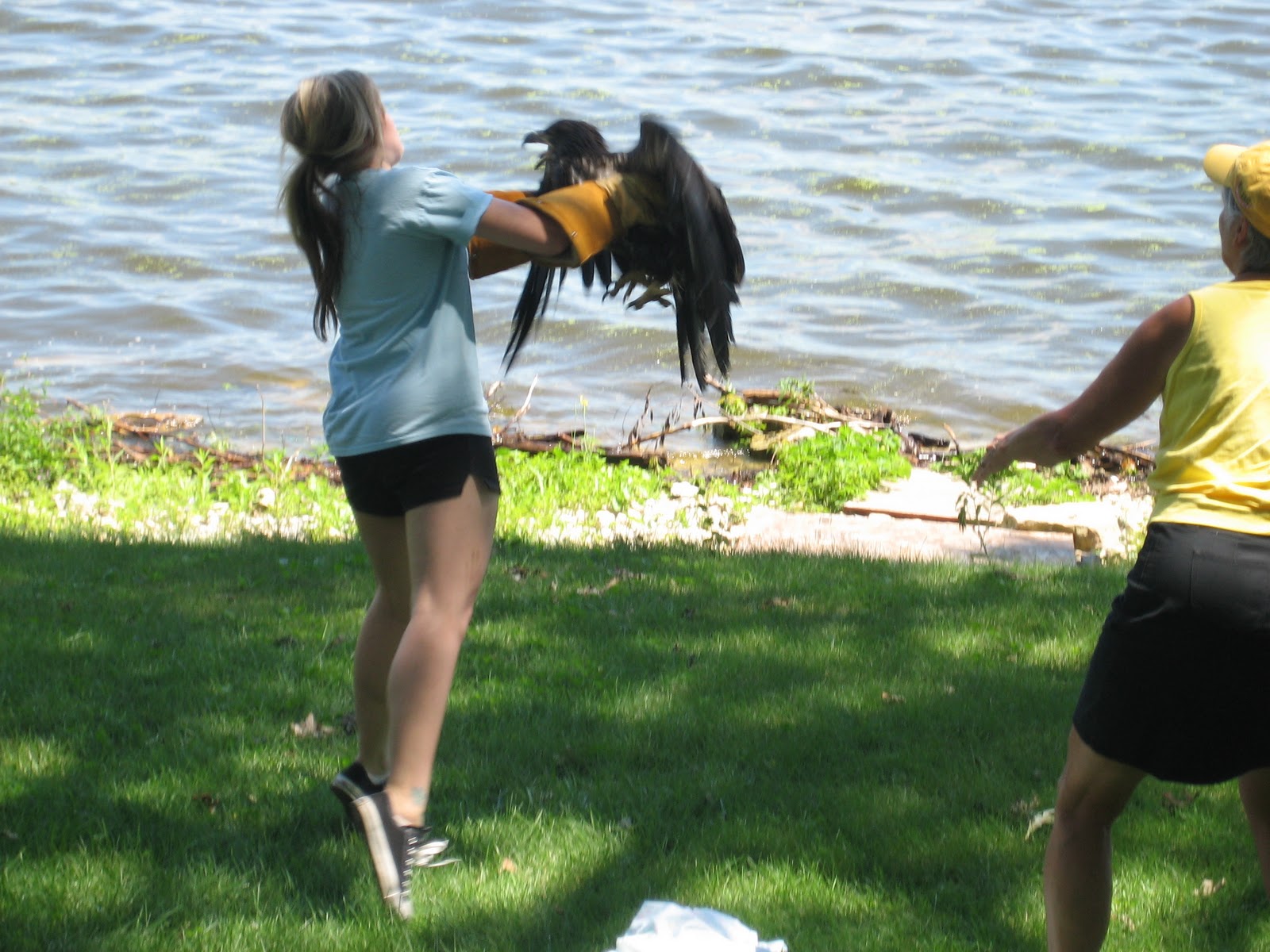
The bald eagle was, as Rick predicted, emaciated, dehydrated and very underweight. After spending just a night at WINC it was transferred to a rehabber at Pineview for expert care in a facility with more resources for the size and care required for this type of bird. After such a difficult rescue Rick wanted to make sure the eagle did well and asked to be kept informed on its rehabilitation progress. After the eagle had been returned to health Rick received another call, but this time it was to be there for the release back into the wild of the eagle he worked so hard to rescue.
Wednesday, April 7, 2010
The Answer is Blowing in the Wind
This is where the Center comes to into the picture. First a baby owl will be found on the ground and brought into the Center. Animal Care staff will do a physical exam on the owl to ensure that it is in good condition. In the meantime, another staff member will visit the rescue site on a “reconnaissance” mission, looking for signs of the old nest, any other members of the family, food remnants, pellets or whitewash. And if they’re lucky, they will see one or both parents in the immediate area.

Once the old nest is located a new site nearby is chosen. The new nest will be constructed of a wicker laundry basket, lined with boughs and secured to the tree with bungee cords. A new nest can last in a tree, three to four years before having to be replaced. Next, the Center will contact one of our tree-climbing volunteers. The tree climbing volunteers are equipped with ropes, harnesses and spikes, exactly like the equipment used by tree trimmers and utility repairmen.
Arrangements will be made with the homeowner to return to their property with the owlet and to place the new nest in the tree. Once there, the owlets are placed inside a container that the tree climber will carry or pull up through the tree until it reaches the new nest. The tree climber will carefully remove the baby owlet(s) from the carrier and place them gently into the nest. All the while, the spotter below will be assisting the climber and searching the nearby trees for the parents.

It’s important that at least one of the parents returns to the nest site within 24 hours of the re-nest, as the owlets need to be fed regularly when they are young. Property owners are asked to watch for parents visiting the nest in the early dawn and late afternoon to evening and report back to the Center their observations. It’s from their information that we know a successful reunion has been made. To date, WINC has received six owlets, five owls in one day alone!
-Guest Blogger KF