Showing posts with label Eagle. Show all posts

Wednesday, January 25, 2012

Raptor ID

For those of you who followed his journey, you can imagine, we received a lot of phone calls about possible sightings of Dakota this past November and December. And in investigating these calls, some of those sightings have been of other raptors than a Great Horned Owl. There are many field guides to birds available which are much more complete, but we thought we’d give you a quick reference to some of these common raptors.


 Dakota is a Great Horned Owl. 22” tall, 44” wingspan, 3.1 lb. Note yellow eyes, ear tufts, white throat patch and horizontal bars on chest as markers. As with all raptors, females are approximately 25-30% larger than males. Dakota is kind of little even for a male. Great Horns are the most common owl in Wisconsin and our largest owls – except when Great Gray Owls or Snowy Owls occasionally come south from Canada in severe winters or lemming population crashes.


A caller was certain they had Dakota. They had an Eastern Screech Owl that had a fractured right furcula (wing bone) and blood in its right eye probably from trauma like being hit by a car or flying into an object. Screech come in 3 color phases : red, brown and gray. 8.5” tall, 18” wingspan, 6 ounces. Note the ear tufts but no white throat patch and much smaller size. But Screech Owls don’t know they are small- Screech’s are very feisty birds.


Barred Owls are our 2nd largest owl common in Wisconsin. 21” tall, 42” wingspan, 1.6 lb.
Note the black eyes. Years ago we got a baby Barred Owl in as a patient and one of our volunteers gasped that it was blind when she saw it. She was used to the yellow Great Horn eyes. No ear tufts, more pronounced facial disk, vertically streaked chest and belly. Even though barred are almost as large as Great Horns in height and wing span, they are about half the weight. These birds are very fluffy.

We also have Short-eared and Long-eared Owls in Wisconsin but they are not as common owls. We may admit one every couple years at WINC. Note that all these owls are stocky with round heads, very little neck definition, and short squat tails. And their heads are big in comparison to their bodies. Owls can see and fly in daylight although they prefer to sit on a branch next to a tree trunk and snooze the day away. If disturbed from their roost by crows, people or activity they will glide away to another location. If owls are having trouble finding food due to inexperience, lack of local food sources, or illness or injury which hampers their hunting, owls will be active in the day in addition to the night looking for food. If you see an owl active in day for several days, that owl may need help. Please call WINC or a wildlife rehabilitator in your area.


We had several calls that Dakota was at the intersection of C and 18, just down the road from our current and our old location. Was he trying to come home? Staff and volunteers have raced to the scene to find a Red-tailed Hawk sitting on a pole. Red-tails are our most common raptor in Wisconsin and we regularly admit them as patients. They often hunt on the roadsides and can be seen often along I-94. Because the ditches are mowed to maintain the roadways, the vegetation that grows there is constantly growing back. That tender new vegetation attracts prey species like Eastern Cottontail rabbits, 13-lined Ground Squirrels and Eastern Chipmunks to feed. The shorter vegetation also makes prey easier to see than dense underbrush. And some of these prey animals get hit by cars and Red-tails are resourceful enough to take advantage of the roadways for all these reasons. Hawks in general are taller and slimmer than owls. They have smaller heads in proportion to their bodies than owls and more pronounced neck and shoulder definition. Red-tails have a white to cream colored throat, chest and belly with faint mottling if any at all. They will soar or sit out in the open in daytime because they are hunting by sight. Red-tails are 19” tall, 49” wingspan, 2.4 lbs.

We began our blog originally to help educate people about native Wisconsin wildlife. When Dakota’s ordeal began it quickly turned into Dakota watch. Throughout the past few months, people have become more aware of owls because of the media stories about Dakota. Not only are we extremely happy for his safe return, he is still teaching people about wildlife even though he has not yet begun to work again!

Dakota, meanwhile, continues to remain well. He loves mealtime and spending daytime hours outdoors so that he can watch the antics of our resident birds and squirrels.

Guest Blogger L.R.

Thursday, November 11, 2010

A Harrowing Rescue Tail

Back in June of this year strong tornados came through southern Wisconsin taking down power lines and causing damage to homes of both people and animals alike. In the days after the storms had passed, one call we received was a caring woman who had a young a bald eagle that she thought was in need of help. Here at the Wildlife In Need Center we generally rely on the public to bring us injured, sick or orphaned wildlife but in some situations we are able to send trained volunteers or staff out on rescues. In this instance, Rick, a dedicated volunteer was able to help. After a long drive winding through the aftermath of the storms and avoiding all of the turtles that had found their way onto the road, Rick finally arrived at the start of his journey.

When Rick arrived at the home of the caller she showed him there they eagle was; perched in a very large tree over a ravine filled with other trees and vines covering the ground. Things were about to get difficult. The branch that the eagle was on was at the same level as the top of the ravine but too far away to simply reach out to. Rick attempted to use a net that was attached to a pole. It was just long enough to reach the bird but it kept getting tangled in the tree. At this point Rick had assessed the bird from a distance and realized that it was a younger bird and that it was pretty emaciated and most likely dehydrated. Because the bird was young, it's likely it was still unskilled in hunting and may have become too weak to fly well. This can be dangerous even though there weren't any substantial injuries because being too weak to fly means that he wouldn't be able to hunt which is how he became weaker to begin with. Rick succeeded in nudging the bird out of the tree and it glided to the ravine floor.

Rick followed the bird into the ravine full of tangled vines. He crept closer and closer to the eagle and just when he had it in his sights, the bird hopped away. This struggle continued across the ravine for about an hour, but even while tripping on and getting tangled in the vines with every move, Rick was not about to give up. He asked for help and even though the woman who called was not able to herself, she found other caring neighbors that could. The new recruits formed a human wall behind the bird to keep it from escaping onto the clearing and Rick moved in again. This time he successfully captured the eagle in a large blanket.

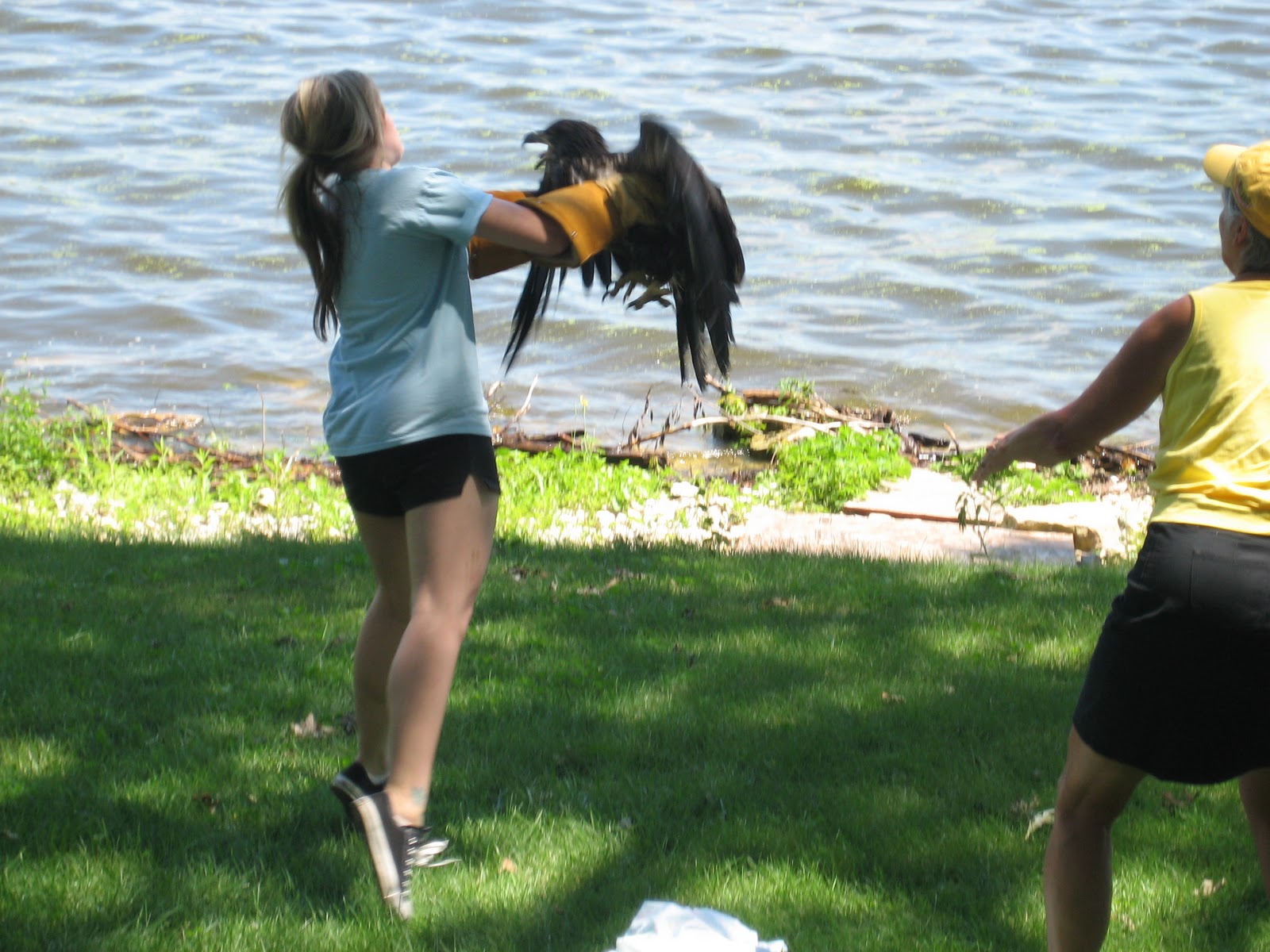
The bald eagle was, as Rick predicted, emaciated, dehydrated and very underweight. After spending just a night at WINC it was transferred to a rehabber at Pineview for expert care in a facility with more resources for the size and care required for this type of bird. After such a difficult rescue Rick wanted to make sure the eagle did well and asked to be kept informed on its rehabilitation progress. After the eagle had been returned to health Rick received another call, but this time it was to be there for the release back into the wild of the eagle he worked so hard to rescue.

Without teamwork this eagle’s story may not have had such a happy ending. Teamwork between staff, volunteers and the public is key in the success of both rescuing and rehabilitating an animal. If this caring woman had not made the call we would have never known there was an eagle in need of our help. Without dedicated volunteers or the other caring individuals who offered assistance, the eagle may not have been able to get the help it needed and this hard to top rescue may not have been such a success.

Rehabbers from the Center the Eagle was transferred to and cared for at release it back to its home territory while Rick photographed the moment he had been hoping to see since he first rescued the bird.