Showing posts with label Rehabilitation resources. Show all posts

Thursday, October 27, 2011

A Tale Of Two Opossums


Being a licensed wildlife rehabilitator makes you look at your surroundings in a different way than most people. When my husband and I drive anywhere, one of the things we are always looking for is good patches of dandelion greens to pick for the many cottontails we rehabilitate each year and the other being any injured animals that may need our help. One animal specifically we notice are any dead opossums because anyone of them could be a mom with babies still alive in her pouch. As the only marsupial in North America, mom opossums carry their young with them in their pouch for a number of weeks. They can have two sets of babies each season, one in spring and one in fall. That is why between April and October it is so important to check any dead opossums you see on the road (where it is safe to stop and check).

So the story goes that we are always on the lookout. On September 11th we found a great patch of dandelion greens in Ottawa. The following Tuesday morning my husband went back there for more greens and saw a squashed mamma opossum (he could tell because there were scattered dead little ones on the road). To keep anyone who would be grateful for the free meal from being in the way of traffic, he dragged her way off the road and started picking greens. After just a little while he started thinking; he’d seen her dead and all the little ones but didn't actually check her pouch. So, back he went to where he had dragged her and sure enough - one little guy was still hanging on - ice cold but alive. He brought him home, weighed him and tucked him into a box on heat to warm up.


That night, I had promised to release some orphaned cottontails in a friend’s yard in the town of Waukesha, so after work we packed them up and hurried over there. All went well with the release, but now it was almost 7pm, getting dark, and we need greens again for overnight and morning for the bunnies that were still at home. We wondered where to go - look around and waste time, or go back to Ottawa, which takes time to drive to, but where we’d be assured of abundant greens. We decided Ottawa was the best choice, so off we went. I started picking down the road one way and him the other. A little later he came over and said he thought he heard something but wasn't sure. I came over by where he was picking and listened but heard nothing. Then, a little sound, and nothing again. We didn't want to walk around for fear of stepping on any little ones, and needless to say, by now it was getting dark and we really had to keep picking greens. So I got down to ground level and started making mamma opossum sounds and my husband got down and began to make baby opossum sounds. Sure enough, in just two seconds we hear another little baby. He'd been out there all that time and was cold as ice, but we found him and as of this writing, he and his brother are doing really well.

So, it just goes to show you, if take the extra time you may be able to help save a life.


Guest Blogger N.M.

Sunday, June 19, 2011

Notice!

The Wildlife In Need Center is moving to its new home!
After several years of searching, rasing funds and support, and negotiating leases, our more efficient, more green, more public-friendly facility will be opening on Monday, June 27th.

To accomodate for the moving process, the Center will not be accepting calls for phone counseling, nor will we be accepting patients to our clinic on:
Thursday, June 23rd
Friday, June 24th
Saturday, June 25th 
Sunday, June 26th

Click here for links to other area resources that can be of assistance if you've found an animal that you think needs help.
We will open the doors at our new facility at W349 S1480 S. Waterville Road Suite B on
Monday, June 27th.
Please note that our new phone number will be (262) 965-3090

Thursday, November 11, 2010

A Harrowing Rescue Tail

Back in June of this year strong tornados came through southern Wisconsin taking down power lines and causing damage to homes of both people and animals alike. In the days after the storms had passed, one call we received was a caring woman who had a young a bald eagle that she thought was in need of help. Here at the Wildlife In Need Center we generally rely on the public to bring us injured, sick or orphaned wildlife but in some situations we are able to send trained volunteers or staff out on rescues. In this instance, Rick, a dedicated volunteer was able to help. After a long drive winding through the aftermath of the storms and avoiding all of the turtles that had found their way onto the road, Rick finally arrived at the start of his journey.

When Rick arrived at the home of the caller she showed him there they eagle was; perched in a very large tree over a ravine filled with other trees and vines covering the ground. Things were about to get difficult. The branch that the eagle was on was at the same level as the top of the ravine but too far away to simply reach out to. Rick attempted to use a net that was attached to a pole. It was just long enough to reach the bird but it kept getting tangled in the tree. At this point Rick had assessed the bird from a distance and realized that it was a younger bird and that it was pretty emaciated and most likely dehydrated. Because the bird was young, it's likely it was still unskilled in hunting and may have become too weak to fly well. This can be dangerous even though there weren't any substantial injuries because being too weak to fly means that he wouldn't be able to hunt which is how he became weaker to begin with. Rick succeeded in nudging the bird out of the tree and it glided to the ravine floor.

Rick followed the bird into the ravine full of tangled vines. He crept closer and closer to the eagle and just when he had it in his sights, the bird hopped away. This struggle continued across the ravine for about an hour, but even while tripping on and getting tangled in the vines with every move, Rick was not about to give up. He asked for help and even though the woman who called was not able to herself, she found other caring neighbors that could. The new recruits formed a human wall behind the bird to keep it from escaping onto the clearing and Rick moved in again. This time he successfully captured the eagle in a large blanket.

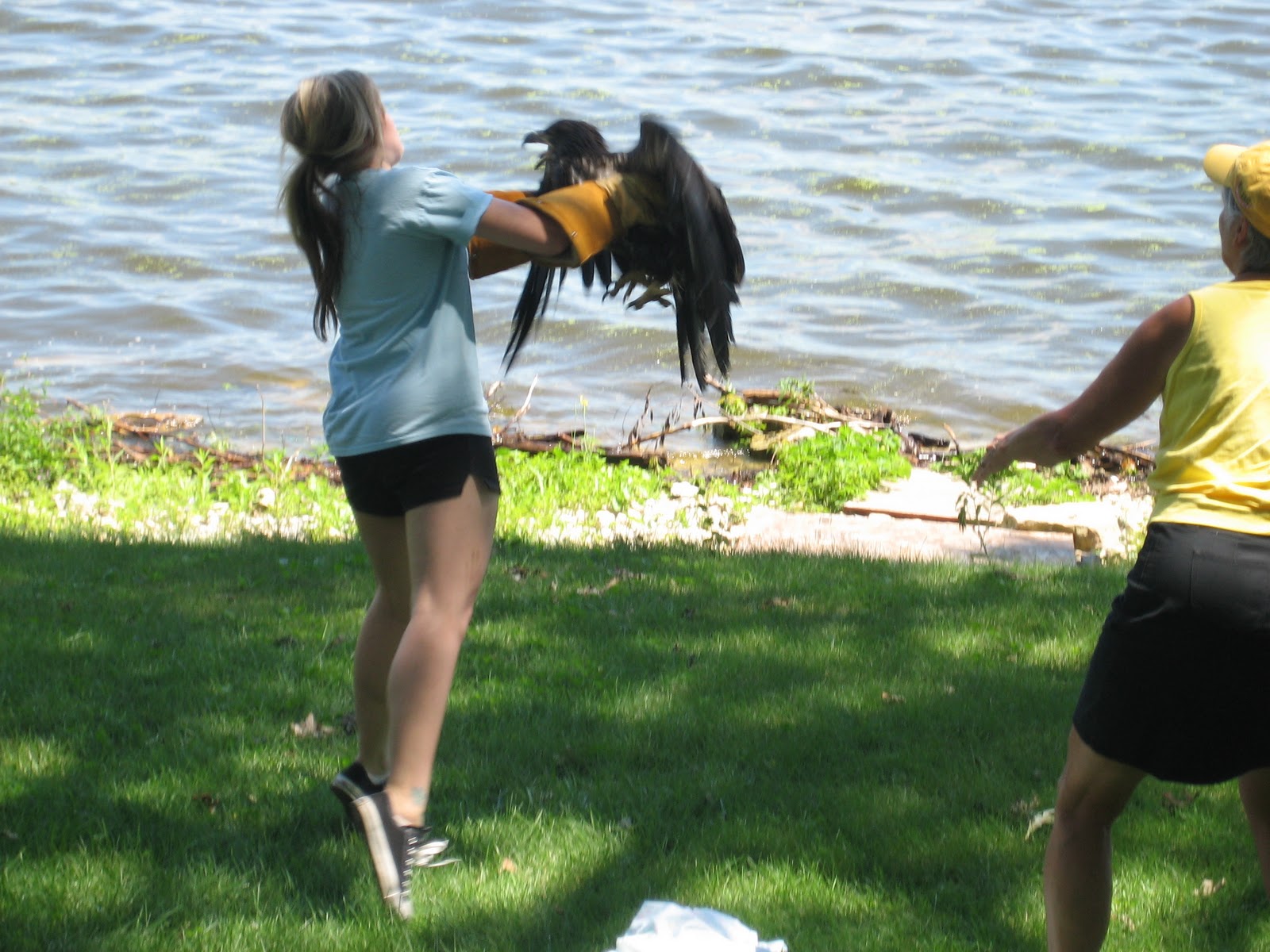
The bald eagle was, as Rick predicted, emaciated, dehydrated and very underweight. After spending just a night at WINC it was transferred to a rehabber at Pineview for expert care in a facility with more resources for the size and care required for this type of bird. After such a difficult rescue Rick wanted to make sure the eagle did well and asked to be kept informed on its rehabilitation progress. After the eagle had been returned to health Rick received another call, but this time it was to be there for the release back into the wild of the eagle he worked so hard to rescue.

Without teamwork this eagle’s story may not have had such a happy ending. Teamwork between staff, volunteers and the public is key in the success of both rescuing and rehabilitating an animal. If this caring woman had not made the call we would have never known there was an eagle in need of our help. Without dedicated volunteers or the other caring individuals who offered assistance, the eagle may not have been able to get the help it needed and this hard to top rescue may not have been such a success.

Rehabbers from the Center the Eagle was transferred to and cared for at release it back to its home territory while Rick photographed the moment he had been hoping to see since he first rescued the bird.

Tuesday, June 22, 2010

Thank You for Helping Wildlife

Do you know how to rescue a Bald Eagle with your finger or and orphaned Gray Squirrel with your wireless mouse? We say it a lot around here at the Wildlife In Need Center and it may sound cliché, but our members and supporters really are saving lives with each donation. Whether it’s an hour of their time, a bottle of green cleaner or a dollar, they all add up to what we need to get the job done.

In-kind donations are a way that we get a tremendous amount of the materials and supplies we need.
In a shameless attempt to win you over with cuteness please review the following photographs:


The following items are things we urgently need due to the large number of patients being admitted daily:

  • Paper Towels
  • Newspapers
  • EVO-Premium Cat Food – (found at Friends of Nature)
  • Plastic Storage Tubs – 10, 18 or 35 gallon sizes
  • Dry erase EXPO markers – black (or any color)
  • Simple Green - (or other similar cleaners like Green Works for example)
  • And of course - Greens - Any type


Whether it’s one donation or 100 we can accept them in our office between 9AM and 5PM seven days a week. Thank you for caring.

You can donate online to support our efforts to help our wild neighbors in need too.


Wednesday, February 24, 2010

Last week I received a call from a woman in New Jersey …

A small bird, likely a Northern Cardinal based on her description, had flown into their window and they had rescued it but couldn’t find anyone in their area to help it. Although infrequent, it is not uncommon for us to receive calls like this. Sometimes someone has found our website online or sometimes someone who used to live in this area will call looking for contacts where they are now residing. Due to some of the severe weather in the south over the past few years we have gotten several calls from people in those areas attempting to rescue animal victims of the storms.

To protect animals (and people) it is illegal to possess a wild animal without the proper permits anywhere in the United States. That is one reason why we always get back to these individuals and do everything we can to get them in contact with someone who is at least in their state who may have access to more local sources. The National and International Wildlife Rehabilitators Associations are our best source for these out-of-state contacts, but anyone would be wise to check with their state and local offices for the Departments of Natural Resources and Fish and Wildlife Service to obtain a more complete listing of all those individuals who are licensed to help our wild neighbors in their own states.


National Rehabilitators Associtation
http://www.nwrawildlife.org
US Fish and Wildlife Service
http://www.fws.gov/faq/rehabfaq.html

If you have a question or are concerned about a wild neighbor that may need help visit our website at http://www.helpingwildlife.org/wldlemergency/wldlresources.htm or call us from 9-5 seven days a week.

If you or someone you know would like to donate resources, skills or time to promote our online and telephone outreach efforts please contact us at donate@helpingwildlife.org