Showing posts with label owlet. Show all posts

Saturday, February 18, 2012

And An Owl In A Pear Tree

Once upon a time we received a phone call from a woman who had an Owl in her pear tree. This owl, she claimed, “must have been injured,” because she had seen it in nearly the same place both the day before as well as today and she was afraid to go outside because of it. We did our best to explain that even if there was something wrong with the owl it wouldn’t pose a threat to a grown adult while it was in a tree and we tried to gather more information from her as to what more was going on to give us an idea if there really could be something wrong with it.

After a short time it was obvious that the caller was coming at the situation from a much different place than we were and was unwilling to provide us with anymore of the information we needed.

The following day, the adult children of this same woman called and tried to tell us the same story of the owl in the pear tree. When I encouraged them to approach the tree to gather more information the same as I had suggested the previous day however, the owl flew away just fine!

The reason I share this story is just an excuse to talk about the fact that baby season is just around the corner and the earliest babies are already being prepared for by their Great Horned Owl parents!

Each year we admit as many as half a dozen or more “owlets” because of strong spring storms and poorly built nests. This is the situation that Dakota was faced with when he was a youngster. As much as he has become a part of the Wildlife In Need Center and who we are over his 11 years with us, his true and ideal place would have been the freedom of living as a wild owl. Because he was taken from his family that blustery spring day rather than brought to a rehabilitator who could’ve reunited him with his family like we do with the owlets we admit, he will never live that life.

Just a reminder that when you find an animal you think needs help, make your first step a positive one and contact your local wildlife rehabilitator before you do anything else!

This puff-ball can't get back up into his parents' nest without a little assistance. This is not a safe place for someone like him to be so if you see this situation, give us a call
An experienced volunteer is gently gathering up the owlet to bring to the Center for evaluation. Once we've determined that there are no injuries we will send out re-nesting volunteers and staff to reunite the babies with their family.
Owlets that are a little larger and more feathered like this one are called "branchers." These little guys may be capable of hoping and gliding enough that if found on the ground they could get back up into the lower branches on their own. If they can't do so in a reasonable amount of time however, always call a rehabilitator for advice 

An Owl Re-nesting Volunteer climbs the tree armed with a new "nest" to install for the owl family
Thank you for caring!

Thursday, July 14, 2011

Grand Opening Ceremony!

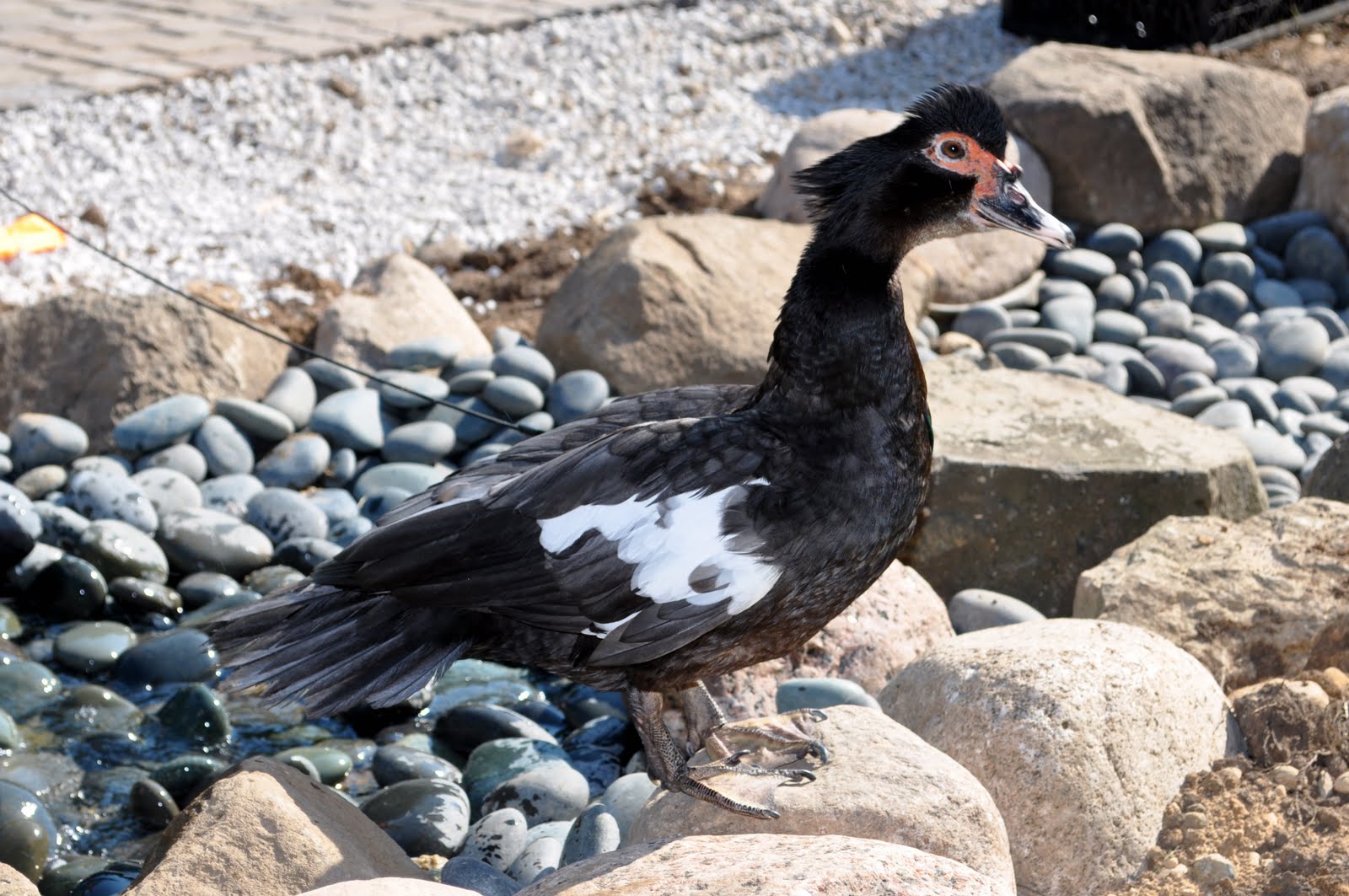
Last week on Thursday, July 7, 2011, we held our official Grand Opening Ceremony for special supporters who made the new building possible.  At the Grand Opening, the board of directors and their families, along with other guests were able to get a walk through tour of the new center.  Two of our Animal Ambassadors were around for the excitement at the Grand Opening. Guests were greeted by Daphne, the Muscovy duck, who was playing in the water feature right outside the front of the new center.

Daphne playing in the water feature and greeting guests.
This exclusive water feature is part of the filtration for a water conservation system enabling the center to reuse water for cleaning and filling ponds.  As guests entered the gathering area, they saw Dakota, the Great Horned Owl with Leslie Kiehl, our education coordinator.  When it was time for the ribbon cutting ceremony, members of the board of directors, UWW’s Marlin Johnson, and County Executive Dan Vrakas shared short speeches on how we have grown over the years.

Guests listening on to the speakers during the ceremony.

  The ribbon was cut with a pair of garden sheers, fitting for our new center.  At the end of the evening, Wildlife Rehabilitators, Cheryl Diehl and Chelsea Matson brought outside a Male Eastern Red Phase Screech Owl to be released.  The release of the owl was great way to symbolize that the center is soaring to great heights of continuing to bring rehabilitation to wildlife. 

Standing in front of the new building ready to cut the ribbon.
We will be hosting public open houses at the new center on Saturday August 27th and Sunday September 11th, 2011 from 1 p.m. – 3 p.m. These will include tours of the new facility led by our volunteers. Additionally, the new center is family friendly, educational, and fun for everyone anytime during office hours.

Guest Blogger: JH

Thursday, March 3, 2011

Here Comes Spring!

Spring is on its way! It’s been 5 days since the first Red-winged Blackbirds were seen visiting the front feeder. This morning they were joined by a multitude of others, singing up a storm in the treetops all across the property! Several staff and volunteers in this area and as far south as Mukwonago have heard Cranes calling as they return to Wisconsin and their breeding grounds!

With the signs of spring increasing daily that means it is the time of year for our Annual Pancake Breakfast and Baby Shower. This event features visits from several of our animal ambassadors, cool WINC merchandise you can purchase to help fund our care of orphaned wildlife this spring. And, most importantly, pancakes, sausage, eggs, corned beef hash, juice, coffee, and homemade baked goods!


Join us Sunday, March 27th between 8AM and 1PM!
The Dousman/Ottawa Lions Club is located at 235 Main Street Dousman, Wisconsin
Tickets are $6; $3 for children 2-12
and children under 2 eat free!

Because this event is to bring awareness to the baby season soon to come we will have educational materials as well as staff and volunteers to answer your wildlife questions. The funds we raise at this event will help us care for literally hundreds of baby raccoons, ducklings, squirrels, songbirds, cottontails, owlets and more! If you want to help even more, consider bringing in an item or two from our baby shower wish list:

Paper towels
Bleach
Simple Green (regular or concentrated)
Bungee Cords
Cloth Diapers
Fleece and Pillowcases
Fresh and frozen berries
Innova Evo Dry Cat and Kitten Food
High Efficiency Laundry Detergent (HE)
Earthworms, Waxworms, and Mealworms

Baby Song Birds will constitute nearly 200 or more of the patients we will care for this season!


Thursday, February 24, 2011

Hung Up

The other day we received a phone call from a gentleman who claimed that while hiking the woods behind his home he and his children had seen a hawk dangling from a tree by one leg. He hadn’t been able to get close enough to tell if there was something tangled up on the leg or what it could be which made the assessment of the situation much more difficult.

He described that it was fairly wooded in and the ground was quite moist from the freezing and thawing streak we had been experiencing. And the bird was several feet from the tree trunk and 15 to 20 feet above the ground. I was at a loss. Even in the winter we are often too busy to send a staff member out for a rescue, and rely on volunteers to assist us with these situations. But how was I going to pin-point a volunteer able to attempt this feat?

Right away we contacted our volunteers who specialize in baby owl re-nesting since they have the equipment needed to climb high trees to put owlets back into their nests. When one finally notified us that he would be available I contacted the caller back to get an update on the situation.

The story gets interesting at this point because the children in the family reported that the hawk had by this point been able to right itself onto the branch but still no one had been able to get a good enough view to discern what, if anything, had caused the bird to be tangled up and hanging from the tree. They suggested that it had been hanging of it’s own accord by its talons, but this is not a normal behavior for hawks so I was still very concerned that the bird was wedded to the tree somehow.

We had a volunteer who wasn’t experienced in owl re-nesting, but who happened to live close by, go out to the site to visit with the callers and see if he could get any more information on the birds (another bird, presumably a mate, had shown up on the scene at this point). When he called back and informed us that not only had both birds “flown the coop” but that he had been shown the pictures taken when the bird was first sighted and it appeared that it had been hanging by its talon; everyone was shocked.

It didn’t take long before someone postulated that there was really no reason to be confused by the situation because there was a simple answer that no one had yet thought of…

It may seem cold and frigid to most of us, but for our wild neighbors love is in the air. Squirrels are performing acrobatics in the trees, the groundhogs are starting to stir in their burrows, and the owls and hawks are starting to seek out their mates and claim their nesting territories. I’ve never seen, but have heard, that when hawks are courting they can be witnessed doing some pretty amazing stunts like grasping talons and falling out of the sky. I’ve heard it described as appearing as though they are “fighting.”

A face only a mother Red-tail could love???

What likely happened, and this really is the best way this story could’ve ended, is that during one of this pairs’ “stunts” one of the hawks lost control and fell into the tree, perhaps grasping the limb to keep from continuing to the ground. We don’t know how long the hawk was there before the family discovered it, perhaps it was a coincidence that they happened along just after it occurred. Once the bird, with its amazing agility, was able to right itself it probably just needed a few moments for the shock to wear off, with its mate there ready to lead it off again. We are VERY glad that there wasn’t anything hanging the bird up and wish these two a happy and successful year. For those poor birds who DO get caught up on wire, string and other debris left behind by humans please keep the following in mind:
  • Nets for outdoor games should always be taken in or down when not in use
  • Fishing line, especially with lures or bait still attached, should never be left behind
  • Kite strings and other types of strings should always be wound up and tied off before discarding

Thursday, May 13, 2010

Meet Dakota


A clear and brisk spring night is often a wonderful time to hear the great horned owl calling to its mate. At WINC our lead education animal ambassador is just such a regal specimen of a raptor.

Dakota came to us 10 years ago from another rehabilitator after it was determined he was imprinted. Poor Dakota had been blown out of his nest during a windy spring day and was picked up by someone who wanted to keep him as a pet. Aside from the fact that this is breaking a federal law, the person did not know how to care for Dakota and before long he became very sick. Once he finally made it to a rehabber, Dakota made a full recovery and has spent the last nine years teaching the public, school children, various organizations and countless scouts to admire our wild neighbors from a distance and not to pick up or interfere.

Should you find an injured or orphaned animal please give us a call so that someone can assist you on how to proceed with rescue and care.
Guest Blogger -LK
Reader Update: The little female badger we took in is no longer alone! After re-hydrating the little girl we contacted another rehabilitator north of here who has much more experience and proper housing for large animals like badgers, coyotes and foxes. Jeannie was delighted to take the orphan in and lucky for both of them a little male was transferred to her a short while later! At last report both members of the new family are doing well. Thanks for caring!

Wednesday, April 7, 2010

The Answer is Blowing in the Wind

Whether March arrives like a lion or a lamb, it’s the month for baby owls. It’s the blowing of the spring winds, which tests the durability of any Great Horned owl nest. You see, Great Horned owls don’t construct their own nests, they move into nests that are already made; built by other raptors, squirrels and crows. Add a full grown parent and two or three owlets and a nest that is old and already weak is bound to give way eventually.

This is where the Center comes to into the picture. First a baby owl will be found on the ground and brought into the Center. Animal Care staff will do a physical exam on the owl to ensure that it is in good condition. In the meantime, another staff member will visit the rescue site on a “reconnaissance” mission, looking for signs of the old nest, any other members of the family, food remnants, pellets or whitewash. And if they’re lucky, they will see one or both parents in the immediate area.


Once the old nest is located a new site nearby is chosen. The new nest will be constructed of a wicker laundry basket, lined with boughs and secured to the tree with bungee cords. A new nest can last in a tree, three to four years before having to be replaced. Next, the Center will contact one of our tree-climbing volunteers. The tree climbing volunteers are equipped with ropes, harnesses and spikes, exactly like the equipment used by tree trimmers and utility repairmen.

Arrangements will be made with the homeowner to return to their property with the owlet and to place the new nest in the tree. Once there, the owlets are placed inside a container that the tree climber will carry or pull up through the tree until it reaches the new nest. The tree climber will carefully remove the baby owlet(s) from the carrier and place them gently into the nest. All the while, the spotter below will be assisting the climber and searching the nearby trees for the parents.


It’s important that at least one of the parents returns to the nest site within 24 hours of the re-nest, as the owlets need to be fed regularly when they are young. Property owners are asked to watch for parents visiting the nest in the early dawn and late afternoon to evening and report back to the Center their observations. It’s from their information that we know a successful reunion has been made. To date, WINC has received six owlets, five owls in one day alone!

-Guest Blogger KF

Wednesday, March 31, 2010

A Happy Ending

The evening of Tues, March 10th I received a phone call at home from Department of Natural Resources Game Warden Dave Walz. I live in Jefferson County and have often met Dave to pick up injured animals to bring to the Center. Dave had rescued an owl that had been tangled in netting at a game bird farm near Ashippun.


He had cut the owl free but didn’t know how long it had been struggling or how severely it was injured. Since it was late, we made arrangements for him to let the owl rest overnight with him and then he dropped it by my house early the next morning for me to bring to the Center. The next morning I discovered it was a small male Great Horned Owl and that he was pretty grouchy about being in captivity.


Upon examination, Animal Care staff discovered minor abrasions and a sprained leg and wing from struggling while tangled in the netting. We wanted to give him a couple days to recover, but we were also concerned to get him released to origin as soon as possible.


Why would we send him back to the area where his injuries had occurred? First of all, raptors are territorial and that was his territory. Also, if he had a mate, she would be sitting on their babies to keep them warm. As the male in the family, he would be expected to do most of the hunting for her and the babies in addition to himself. While he was here we had several warm nights so hopefully mom could safely leave the babies for a short while to hunt.


On Sunday, March 14th after work, I drove Mr. Great Horned (as we lovingly referred to this stout little guy during his stay) back home. There was a long gravel driveway to a ridge that dropped away towards the property where I parked my vehicle. He was footing (grabbing with his talons) the door in his excitement by this time. I opened the door, he took one hop onto the road, then threw out his wings and flung himself into the air.


He soared off the ridge, down over the valley, past a pond and landed in a tree to get his bearings. It was so beautiful to see him fly off into the sunset. I hope he got back to his mate in time to help care for his young - Although I do wonder just how he will explain his absence of several nights to his mate. “Really, honey, I was hunting for mice and this stuff grabbed me. And then these aliens abducted me and took me somewhere and performed medical procedures on me…”


Guest Blogger LR
Here's a sneak peak at someone you'll be hearing about in the next couple of weeks... stay tuned

Wednesday, March 3, 2010

Hooos Out There!

In 2009, the Wildlife in Need Center was involved in eleven rescues of baby Great Horned owls, or owlets as they are called. Owlets often have to be rescued when the strong winds of late March and early April blow. Great Horned owls do not build their own nests, but take over old crow and squirrel nests and if those nests are in disrepair, it is very easy for an owlet to tumble out, especially when it is windy. An owlet on the ground is especially vulnerable to predators as they are unable to fly. Crows can often be heard “cawing” when there is an owl in the neighborhood. There is nothing they would like better than to pick on an unsuspecting grounded owlet. Usually if someone from the public is aware of owls in their yard and if a tragedy like this would occur, they will call and notify the Center.

To satisfy my curiosity about owl activity in the area this year, I called many of the rescue locations from the previous year. I’m happy to report, that over half of the contacts to date are reporting a lot of hooting. Several individuals have seen adult owls in trees in their yards. Great Horned owlets have even hatched at some locations. Follow this link to the WE-Energies website http://www.we-energies.com/environmental/protect_wildlife.htm. There you can see two owlets snuggling under the feathers of its mother at 3PM today. At the Center last year, we rescued owlets from late March to late April. In my next blog, I’ll write more about the renesting process. I’ll leave you with this picture, courtesy of a homeowner from one of last year’s re-nesting sites. These two owls are nest mates shown shortly after they fledged last year.


-KF (aka CBL)