Showing posts with label living with wildlife. Show all posts

Saturday, February 18, 2012

And An Owl In A Pear Tree

Once upon a time we received a phone call from a woman who had an Owl in her pear tree. This owl, she claimed, “must have been injured,” because she had seen it in nearly the same place both the day before as well as today and she was afraid to go outside because of it. We did our best to explain that even if there was something wrong with the owl it wouldn’t pose a threat to a grown adult while it was in a tree and we tried to gather more information from her as to what more was going on to give us an idea if there really could be something wrong with it.

After a short time it was obvious that the caller was coming at the situation from a much different place than we were and was unwilling to provide us with anymore of the information we needed.

The following day, the adult children of this same woman called and tried to tell us the same story of the owl in the pear tree. When I encouraged them to approach the tree to gather more information the same as I had suggested the previous day however, the owl flew away just fine!

The reason I share this story is just an excuse to talk about the fact that baby season is just around the corner and the earliest babies are already being prepared for by their Great Horned Owl parents!

Each year we admit as many as half a dozen or more “owlets” because of strong spring storms and poorly built nests. This is the situation that Dakota was faced with when he was a youngster. As much as he has become a part of the Wildlife In Need Center and who we are over his 11 years with us, his true and ideal place would have been the freedom of living as a wild owl. Because he was taken from his family that blustery spring day rather than brought to a rehabilitator who could’ve reunited him with his family like we do with the owlets we admit, he will never live that life.

Just a reminder that when you find an animal you think needs help, make your first step a positive one and contact your local wildlife rehabilitator before you do anything else!

This puff-ball can't get back up into his parents' nest without a little assistance. This is not a safe place for someone like him to be so if you see this situation, give us a call
An experienced volunteer is gently gathering up the owlet to bring to the Center for evaluation. Once we've determined that there are no injuries we will send out re-nesting volunteers and staff to reunite the babies with their family.
Owlets that are a little larger and more feathered like this one are called "branchers." These little guys may be capable of hoping and gliding enough that if found on the ground they could get back up into the lower branches on their own. If they can't do so in a reasonable amount of time however, always call a rehabilitator for advice 

An Owl Re-nesting Volunteer climbs the tree armed with a new "nest" to install for the owl family
Thank you for caring!

Saturday, December 3, 2011

Increasing Dakota Awareness & Education


This has been a very busy week for us at WINC, due in large part to our efforts to continue to reach out to the community and increase awareness of Dakota’s situation. We know our efforts are working, because we have been contacted by so many new people who have reached out to us: people who have just started following our blog & our facebook page, people who have now seen our flyers and heard about our search locally, and people who are becoming aware of Dakota from news stories and the internet. It is an amazing thing to see, just how many people have been touched by Dakota’s plight, and the awesome distances his story has traveled. We have been getting calls from as far away as Canada, from people who want to share information with us & help us in any way they are able, and to contribute ideas to our efforts to see Dakota home once again. It cannot be overstated how heartened we are for the continued well wishes and positive support we receive. If there has been any upside to this sad situation, it has been the constant stream of caring we have been blessed with. We are humbled by the generosity of spirit the community has for Dakota, and overwhelmed by how he continues to educate, even during this current situation.

As a part of our education and outreach efforts, we would like to remind everyone that during this difficult time for WINC, one of the things that is of the utmost importance to us is that we return the respect we have received. We are ever mindful that we want our impact on the community to be a positive one, and ever mindful that the example we set in our search methods allows us to achieve maximum impact with a minimum “footprint”. We are striving to be very respectful of the people who live in the neighborhoods we are searching in, and are therefore keeping our search parties small and quiet in nature. We are so very grateful for the opportunities we have been given to search on private property with permission, and wish to publicly thank everyone who has so graciously allowed us to continue searching on their land. We are also grateful that everyone who has offered to help us search has continued to contact WINC before acting alone, and has allowed us to take the lead on any organized searches. This in turn has allowed us to conduct ongoing searches with minimal disturbance to the community, and maximum respect to it.  No search parties organized by WINC will ever venture onto private property wihout permission.

We are also mindful of the impact our searches have on the environment, and mindful that we continue to fulfill our core mission of helping wildlife in need, and not creating any in the process by disturbing the existing balance. We have been very careful not to create nuisances, both by being selective of where we place our feeding stations, and not disturbing the patterns of existing wildlife in any of the areas we are searching. Above all else, we would never want our efforts in our search for Dakota to bring any harm to the existing wildlife in the areas we are searching. We take extreme care not to harass any wildlife in those areas, and to be respectful of their habitats & not disturb them. Again, we want to thank everyone who has chosen to help us to watch out for Dakota for the care they have also taken and continue to take, to always be respectful of the wildlife that lives in those areas. Though we have stated it in our poster, it bears repeating: if you spot a Great Horned Owl that you believe to be Dakota, please, please, PLEASE do not approach him or call to him.  Please watch him closely while being extremely quiet, and contact the Wildlife In Need Center immediately. Dakota will respond to his handlers, and may be frightened by people he does not already know and is comfortable with.  We would not want anyone to inadvertantly further traumatize Dakota, or unduly traumatize any other owl(s) in the area who might be mistaken for Dakota.

During this past week we have continued to hand out informational flyers during our daily foot searchs, and have followed up on many leads from people who have reported hearing owls in their area. Unfortunately, we still have not been successful in pinpointing Dakota's exact location. We have heard owl calls from time to time, but not always received responses that we could definitively identify as Dakota’s. We have made some minor changes to the locations of the feeding stations, but still have not seen any measurable evidence that he is visiting them. Even though it may seem obvious, one of the things that people sometimes forget is that, even if he is not catching live prey, Dakota will eat dead animals. And even if he is not visiting the feeding stations to do so, he may be finding other food in that manner. We remain optimistic that Dakota is eating on his own.

We also remain optimistic Dakota remains in the general area. There is a statistic on released owls that points to most of them staying in a 5-mile radius from the area they are released in. As we know the approximate area Dakota was in when he escaped his captors, we have a fairly good idea of the areas we need to be most watchful for him in. Additionally, part of that range for us includes both our current building and grounds, and our old building. We have had many people ask, and yes---we do search the premises around our old building on a regular basis, on the chance Dakota has found his way back to that area.

The most important thing that we want people to remember is, we have not given up on our efforts to locate Dakota. We absolutely believe he is out there, and we will absolutely continue to search for him, and continue to raise awareness of him throughout the community. The eyes and the ears of the local community are one of the greatest resources we have available to us.  We have know from the very beginning that this would not be an easy process, but we remain committed to bringing him home. He is such an important member of our family, we are not whole without him.


Please continue to help us to find Dakota by remaining observant and vigilant especially when you are in the Dousman/Hunter’s Lake area. We have an improved version of our original flyer available & attached to this blog for download. We've added some specific information about Dakota's behavior and habits that we hope will prove helpful in further increasing education & raising awareness of Dakota in the local community. As previously mentioned, we’d like to again invite everyone to please feel free to print out the picture of the flyer included with this blog and post it-----WITH PERMISSION = please do not post it or distribute it unless you have the expressed permission of any given property owner, business, school---etc. 
((Reminder: it is ILLEGAL to place flyers in mailboxes.))

Thank you for your continued support of Dakota, and of WINC. Please continue to keep the faith that he remains strong, and will be home with us again soon.


(Guest Blogger K.P.)


Wednesday, November 16, 2011

A Hopeful Progress Report


We wanted to check in again & update everyone on our progress in our search for Dakota.  

Search parties were out all day and early evening Tuesday, south of Hunters Lake/Dousman. We had several sightings and vocalizations. We’re secure in our belief that Dakota is in that area, as he has responded to Leslie’s voice several times and we recognize some of his “special” vocalizations. We were confused initially by sightings and vocalizations that seemed to be in different areas, sometimes at the same time. We now feel there are 2-3 owls other than Dakota in the area: a youngster from this year who makes begging cries for food when staff hoots, and 1 or 2 adults who are probably its parents.

We’ve had so many offers of search help, and want to again express how very grateful we are for the kindness and caring of everyone who has been touched by Dakota's plight. After several searches over the past few days, staff has decided that the best approach is to just attempt recovery with staff members, who Dakota is the most familiar with and comfortable around. We are also very mindful that we don’t want to lose our permission to search on these private properties by becoming a nuisance.  We think our best chance of recovery is with people Dakota knows well, especially since he is so traumatized.  We don’ t want anyone not familiar with (or familiar to) Dakota to try to grab him and be inadvertently hurt, or further scare Dakota. So at this time, we would ask that everyone (including our Animal Care Volunteers) stop going to this area, and not call or look for Dakota. If our staff members are the only ones calling for him, he is more likely to come to staff. But we want to again express how very grateful we are for all of the help we have already received and all of your generous offers.  We are blessed to be surrounded by so many people who care so greatly about Dakota, and bringing him home.

We did want to additionally remind everyone, in the further interest of public safety: deer gun season starts this Saturday, and there are several deer/tree stands in the woods where Dakota is staying. It’s too dangerous for any one of us to be moving in the woods even with blaze orange, and we need to respect the hunter’s rights.  But one house nearest to Dakota has generously agreed to let us use their yard as a feeding station & set up their trail cam on it. Even though owls in the wild do not eat every single day, without likely having eaten for several days now, Dakota is going to be getting very hungry. Staff is going to call from that feeding station starting Wed afternoon/night to draw Dakota to that area which we can safely access during hunting. Once Dakota starts feeding there, we think he may come to us, or we can utilize raptor traps.

As always, we simply cannot thank everyone enough for their kind wishes and help. We are especially grateful to the people who reported the Facebook page to the Waukesha County Sheriff’s Department, and to us. That was the tip that led to the arrests, and to the information on Dakota’s location. I know some of the people I talked to wanted to be anonymous because they were worried about retribution from these suspects and their friends. It was courageous of them to report the information.  

Thank you all for caring about Dakota, and please keep him in your thoughts and prayers.  All of the positive energy everyone has been sending our way is so very, very appreciated.


(Guest Bloggers L.R. & K.P.)

Wednesday, September 28, 2011

Fall Fowl


Much like our feathered friend, Daphne, water and shore birds who are unable to migrate due to injury - or being domestic! - are going to become more obviously in need as the weather cools and the healthy animals begin to head south.
 Whether you like them or not, Geese and ducks are a big part of the fall landscape in southeastern Wisconsin. Large flocks descend on recently harvested corn fields and area lakes and streams. This is also the time of year when caring people will start to notice those unfortunate souls who get left behind due to injuries they may be suffering from.

Waterfowl poses a number of diffculties that we don't face with other types of animals. The saying goes around WINC, "they don't call them wild goose chases for nothing." Of course each situation is different, but many have the same obstacles to overcome:
  • The bird spends most of its time on water where it is difficult or impossible for a human (or any other predator) to catch him.
  • The bird can still run even when she does come out of the water making it easier for her to duck, dive and hide in the bushes where she’s safe from predators (us)
  • The bird can still fly even though they have a debilitating leg or foot injury. They will often stay in the water which supports their weight, only coming up on land for brief periods.
The reason many of the calls we receive about waterfowl this time of year are difficult is that injuries sustained a few weeks (in some cases even a few months) ago are oftentimes unrepairable. If an injury is severe enough to keep a bird from doing what comes natural to it, namely flying, and it goes unnoticed and untreated for too long, the chance that we will be able to re-set it and coax it to heal properly is small. Due to regulations (and the inability to survive if done so) we cannot generally just amputate the injured area either. Even if we could amputate, the animal's overall health is often not good enough to ensure their survival through the process or follow-up care; and permanent placement is difficult to find if the injury area will require ongoing medical attention or care.

If you see a goose, duck or other type of water or shore bird that you think needs help please gather the following information before contacting your nearest rehabilitator.
  • Where has the animal been seen most often and how near is it to water?
  • What behaviors (holding out or dragging one wing, noticeably limping, unable to balance) are you witnessing that could help us pinpoint the injury?
  • How close has a person walking (not a vehicle) been able to get to the animal before it responds (ie. tries to run away, dives into the water, or perhaps it can’t move at all)
With birds that aren’t yet approachable but are obviously injured the best situation would be for someone frequenting the area to offer up small tidbits of food like cracked corn, rolled oats or bird seed. This lulls the animal into a sense of security and will hopefully give that individual or one of our volunteers a better chance at getting close enough to contain the animal.

With many waterfowl species coming into season for licensed hunting please be careful when attempting to assist a bird in need. When in any area where hunting could potentially occur, always be on alert and be sure to wear bright clothing so that any potential hunters in the vicinity can see you too. If you have any questions about an animal you think needs help always contact your local rehabilitator for advice and guidance.

Thursday, September 15, 2011

Interested in helping wildlife? We NEED you!

Our wild neighbors need your help! Interns at the Wildlife In Need Center have helped care for thousands of animals over the years through hours of cleaning, feeding and care. But we also offer internships for those looking for experience in Community Outreach as well. The Community Outreach Interns have the opportunity to save just as many lives over as the Animal Care Interns do in our clinic; by providing education to thousands of children and area residents with the help of our animal ambassadors, by spreading awareness of the Center and our services to more people throughout the region, and by talking directly with the public in an effort to prevent the situations that may lead to an animal becoming one of our patients.

Last year the Wildlife In Need Center received a generous donation from the James E. Dutton Foundation. As our Center grows and our need to educate the communities we serve grows with it we have also begun to expand our internship programs accordingly. Our new partnership with UW-Waukesha means that we are enhancing the experiences and learning opportunities even more as we look towards the future.

We are looking for someone to help us in our relatively new Environmental Education and Communications Internship (EC) program. If you or someone you know might be interested in:
  • Learning how to assist the public with wild neighbor questions
  • Designing educational brochures for children’s programs
  • Creating educational displays and brochures for educating the public
  • Helping to present educational programs to the public
  • Creating and editing educational videos
  • and more...
Learning to live peacefully with wildlife as well as knowing when a wild animal may need our help are just some of the lessons you could share with others if you were an education intern at the Wildlife In Need Center.

We are also looking for someone to help us in the Marketing and Community Outreach Internship (MC) program. If you or someone you know might be interested in:

  • Learning how to coordinate a membership program and a variety of donor events
  • Creating and publishing images, videos, and other information online
  • Helping to interact with supporters through social media
  • Creating educational displays and brochures for educating the public
  • Learning how to assist the public with wild neighbor questions
  • and more...
If you want to help inspire and educate people both young and old about the wonder of the world around us then we want to hear from you! If think you’re the right fit to help WINC with Community Education and Outreach than we need to hear from you!

To apply send a cover letter describing your interest and previous experience as well as a current resume to sacummings@helpingwildlife.org For more information about WINC’s intern program visit our internship page.

Want to help but can't commit to a formal internship? Consider becoming a volunteer. We have orientations scheduled monthly and once you've completed training you can come in just once or twice a week! Visit our volunteer page for more information.

Wednesday, August 10, 2011

The Busiest Day

June is always our busiest month of the year at the height of summer and prime time for summer babies as well as adult wildlife. And every year one of those busy June days yields the “Most Patients Admitted in a Single Day.” In 2011 that day was Friday, June 3 when we admitted 30 animals of 8 species.


Species                 Age           Reason for admission     City of Origin


American Woodcock     Adult       internal injuries             Waukesha


Big Brown Bat     Adult     Found in garage, unable to fly      Brookfield


Common Grackle     Juvenile  Unable to fly, fractured wings    Jefferson


Common Grackle      Juvenile    Found on ground calling        Sullivan


Eastern Cottontail        Infant    Nest found by cat               Hartland


Eastern Cottontail        Infant    Nest found by cat               Hartland


Eastern Cottontail        Infant    Nest found by cat               Hartland


Eastern Cottontail       Infant     Nest found by cat               Hartland


Eastern Cottontail        Infant    Nest found by cat               Hartland


Eastern Cottontail        Infant     Nest found by cat              Hartland


Eastern Cottontail        Infant      Cat attack                        Mukwonago


Eastern Cottontail        Infant      Cat attack                        Mukwonago


Eastern Cottontail        Infant      Cat attack                        Mukwonago


Eastern Cottontail        Infant       Cat attack                        Mukwonago


Eastern Cottontail        Infant      Dog Attack                         Hartland


Eastern Cottontail   Juvenile   Nest dug up while landscaping   Watertown


Eastern Cottontail   Juvenile   Nest dug up while landscaping   Watertown


Eastern Cottontail   Juvenile   Nest dug up while landscaping   Watertown


Eastern Cottontail   Juvenile   Nest dug up while landscaping   Watertown


Eastern Cottontail   Juvenile   Nest dug up while landscaping   Watertown


Eastern Cottontail   Juvenile   Nest dug up while landscaping    Watertown


Eastern Gray Squirrel    Infant      Fell from tree               Oconomowoc


Eastern Gray Squirrel   Juvenile    Fell from tree               Oconomowoc


European Starling    Juvenile    CNS issue/disorder           Waukesha


Raccoon           Juvenile    Fell out of tree onto driveway    Mukwonago


Raccoon            Juvenile   Mom hit by car                      Oconomowoc


Raccoon            Juvenile   Mom hit by car                      Oconomowoc


Raccoon            Juvenile   Found in garage screaming      East Troy


Raccoon            Juvenile   Found in garage screaming      East Troy


Wood Duck         Infant     Wandering in road                    Waterloo

A close second in admissions was Monday, June 27 with 29 animals admitted of 14 different species. Does that date sound familiar? That was the opening day for our new facility! I guess the wildlife all wanted to be the first to see the new building. Here’s who came in that day.

Species               Age           Reason for admission                   City of Origin


American Crow     Adult    Found along road with fractured spine   Brookfield


American Toad    Adult     Found in yard disemboweled                Eagle


House Finch         Adult                Stuck in Jelly                         Dousman


Midland Painted Turtle    Adult       Hit by Car, fractured bridge      Waukesha


Mourning Dove       Adult      Flapping on ground, fractured keel             Hartland


Western Painted Turtle  Adult    Hit By Car, fractured shell, spinal injuries    Colgate


Woodchuck                   Adult      Hit by car, fractured leg              Delafield


Brown-headed Cowbird   Infant  Blown out of nest, fractured leg     Waukesha


Brown-headed Cowbird     Infant     Blown out of nest                  Waukesha


Sandhill Crane      Infant         Dog scared away parents           Oconomowoc


American Robin    Juvenile      Found on ground, CNS issues    New Berlin


American Robin    Juvenile      Found on ground                        Waukesha


American Robin   Juvenile       Found on sidewalk                     Waukesha


American Robin  Juvenile       Found on sidewalk                       Waukesha


American Robin   Juvenile       Found on sidewalk                      Waukesha


Brown Thrasher   Juvenile       Found on ground, CNS issues      Waukesha


European Starling    Juvenile   Fell out of nest, fractured wing      Oconomowoc


House Finch   Juvenile  Mom stopped going to nest 2 days ago    Delafield


House Finch   Juvenile  Mom stopped going to nest 2 days ago    Delafield


House Finch   Juvenile  Mom stopped going to nest 2 days ago    Delafield


House Finch   Juvenile  Mom stopped going to nest 2 days ago    Delafield


House Finch   Juvenile   Mom stopped going to nest 2 days ago    Delafield


Raccoon         Juvenile     Found in yard limping             Oconomowoc


Raccoon         Juvenile     Found on road, fractured leg    Waukesha


Mallard           Infant          No Mom                               Waukesha


Mallard           Infant          No Mom                               Waukesha


Mallard           Infant          No Mom                                Waukesha


Mallard           Infant           No Mom                               Waukesha


Mallard           Infant           No Mom                               Waukesha


For the entire month of June the Wildlife In Need Center admitted 443 wildlife patients of 56 different species. And we packed, moved and unpacked the entire operation as well that month including moving all the patients we had in care from the previous months. June was pretty busy for all the tired staff and wonderful volunteers of WINC. But our new home is wonderful and was worth all the hard work!

June 2011                             Species Number


13 lined Ground Squirrel             8


American Crow                          4


American Robin                        42


American Toad                           2


American Woodcock                  1


Baltimore Oriole                         1


Barn Swallow                             3


Big Brown Bat                            3


Black-capped Chickadee         10


Blue Jay                                     1


Brown Thrasher                         1


Brown-headed Cowbird            2


Canada Goose                          2


Chimney Swift                           1


Cliff Swallow                             1


Common Grackle                     11


Downy Woodpecker                 5


Eastern Bluebird                         1


Eastern Chipmunk                    11


Eastern Cottontail                     57


Eastern Gray Squirrel                 9


European Starling                     19


Great Blue Heron                       1


Great Horned Owl                     2


Green Frog                                1


Hooded Merganser                    1


House Finch                             15


House Sparrow                        14


Mallard                                    40


Midland Painted Turtle               2


Mourning Dove                        11


Muscovy Duck                           1


Northern Cardinal                       1


Northern Flicker                         1


Painted Turtle                             1


Raccoon                                  80


Red Fox                                     1


Red Squirrel                                2


Red-bellied Woodpecker            3


Red-tailed Hawk                         6


Red-winged Blackbird                 1


Rock Pigeon                                3


Ruby-throated Humming Bird      2


Sandhill Crane                             2


Snapping Turtle                           4


Sora                                            1


Southern Flying Squirrel               1


Tree Swallow                              1


Virginia Opossum                      14


Western Painted Turtle                5


White-breasted Nuthatch             1


White-footed Mouse                   1


White-tailed Deer                        1


Wild Turkey                                2


Wood Duck                              16


Woodchuck                              10

Wednesday, July 27, 2011

New Nest, Same Story

So you think you’ve found a baby bird…


photo by LMB
The first question to ask is this really a baby bird or is it a small adult bird?

The second question is what was the bird doing before you discovered it and what has it been doing since? Also note whether or not any injuries are obvious.

It may seem like baby birds are a product of spring, but here in Wisconsin we have several species of songbirds that nest later in the season and also some that nest several times throughout the season. Just because it’s July doesn’t mean baby bird season has stopped here at the Wildlife In Need Center!

So, what do you do now that you’ve found a baby bird?

Baby birds that still have lots of pink skin showing and whose feathers are soft and fuzzy or nonexistent are called nestlings. Nestlings are babies that should be in the nest but may fall out due to weather, predators, or other forces. Baby birds that don’t have any obvious injuries should first be warmed up to body temperature under a lamp, on a heating pad, or in your hand before being renested. Those that can be replaced in their original nest should be. In cases where the nest has been destroyed or is too high to reach the baby can be replaced in a substitute nest. A substitute nest can be made of a wicker basket, hanging plant basket or any plastic container with drainage holes poked into it. If using a plastic container be sure to line it with dried grasses, sticks or leaves so that it isn’t slippery. Hang your substitute nest at least 4-6 feet off the ground so it is out of easy reach of neighborhood pets and kids and within hearing distance (less than 12 feet) of the original nest. Don’t feed the baby; it should be hungry and peep because of it – that noise alerts the parents to where it is and they will feed it as well as any siblings in the nest.

Fledglings are babies that are old enough to leave the nest. They spend a couple of days hopping around the ground and making buzz flights an inch or two above the ground a foot or two at a time. That is how they learn to fly and build up their strength; activities they can’t do in a nest. Their parents continue to feed them on the ground but don’t stay with the baby at all times. Fledglings are mostly feathered, with wing feathers and at least a start of tail feathers, but may still have a bit of baby fluff here and there. Babies at this stage should be left alone and monitored from a distance.

If you have any further questions or you feel that the baby bird you’ve found may be injured please contact your nearest wildlife rehabilitator as soon as possible.

Thursday, July 14, 2011

Grand Opening Ceremony!

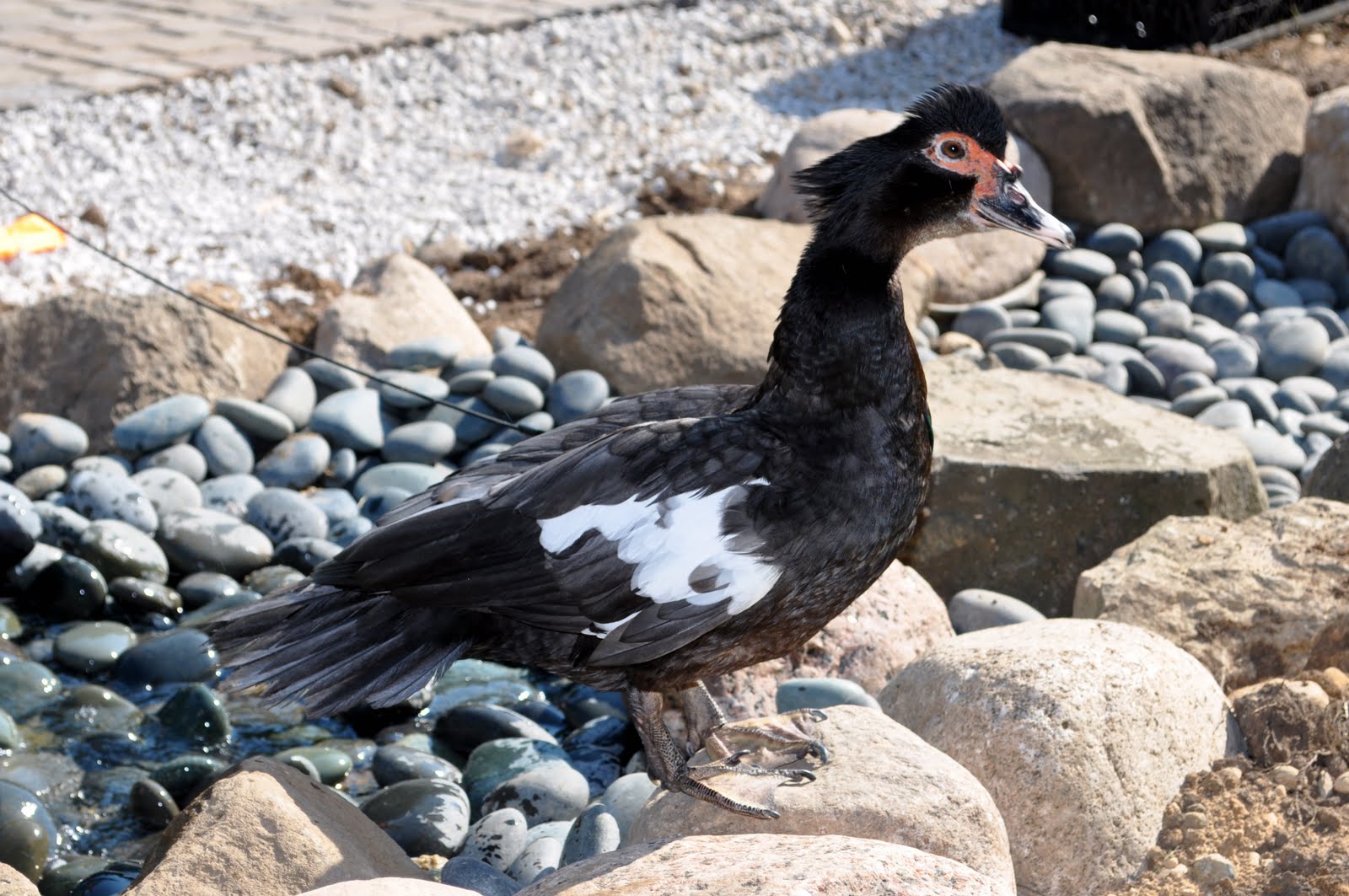
Last week on Thursday, July 7, 2011, we held our official Grand Opening Ceremony for special supporters who made the new building possible.  At the Grand Opening, the board of directors and their families, along with other guests were able to get a walk through tour of the new center.  Two of our Animal Ambassadors were around for the excitement at the Grand Opening. Guests were greeted by Daphne, the Muscovy duck, who was playing in the water feature right outside the front of the new center.

Daphne playing in the water feature and greeting guests.
This exclusive water feature is part of the filtration for a water conservation system enabling the center to reuse water for cleaning and filling ponds.  As guests entered the gathering area, they saw Dakota, the Great Horned Owl with Leslie Kiehl, our education coordinator.  When it was time for the ribbon cutting ceremony, members of the board of directors, UWW’s Marlin Johnson, and County Executive Dan Vrakas shared short speeches on how we have grown over the years.

Guests listening on to the speakers during the ceremony.

  The ribbon was cut with a pair of garden sheers, fitting for our new center.  At the end of the evening, Wildlife Rehabilitators, Cheryl Diehl and Chelsea Matson brought outside a Male Eastern Red Phase Screech Owl to be released.  The release of the owl was great way to symbolize that the center is soaring to great heights of continuing to bring rehabilitation to wildlife. 

Standing in front of the new building ready to cut the ribbon.
We will be hosting public open houses at the new center on Saturday August 27th and Sunday September 11th, 2011 from 1 p.m. – 3 p.m. These will include tours of the new facility led by our volunteers. Additionally, the new center is family friendly, educational, and fun for everyone anytime during office hours.

Guest Blogger: JH

Friday, June 10, 2011

Please Help! : Oconomowoc Duck


For the past week calls have been flooding into both the Wildlife In Need Center as well as the Oconomowoc Police Department regarding a male Mallard duck with reportedly an arrow or dart bisecting his upper neck and/or head area.

Regrettably, both those who have reported sighting the duck as well as those who have gone to the area in efforts to help the duck have not had luck in getting close enough to contain it to bring it in for care.

If you know anything about the incident or individual who inflicted this upon an innocent animal please contact the U.S. Fish and Wildlife Services at 612-713-5360. According to the Migratory Bird Treaty Act of 1918, it is ruled that all migratory birds and their parts (including their eggs, nests, and feathers) are completely protected. (16 U.S.C. 703, more in detail go to http://www.fws.gov/laws/lawsdigest/migtrea.html ) Lastly, P.L. 105-312 also revised the law to permit the fine for misdemeanor convictions under the Migratory Bird Treaty Act to be up to $15,000, rather than $5,000.

If you encounter the duck; try to stay calm when you move toward it. If you can get close enough the best thing to do is to gently toss a sheet or light towel over as much of him as you can. Birds are more docile when they cannot see. However, it is apparent that with his condition it may not be possible to cover the head completely. Once covered, softly tug on the edges of the sheet to cinch them together and try to nudge him into a box or container as tenderly as possible.

The Wildlife In Need Center’s office is staffed from 9AM to 5PM seven days a week including all of the summer holidays. If you have any information on this duck or are willing and able to assist in his capture please contact us at (262) 968-5075. The Wildlife In Need Center is dedicated to providing wildlife rehabilitation to Wisconsin wildlife with the intent to release back to their native habitat, conduct research designed to further the positive impact of rehabilitation, and provide quality community education programs and services. On Monday, June 27th, the new Wildlife In Need Center will be open for business at its new location at W349 S1480 Suite B South Waterville Rd, Oconomowoc, WI 53066. Thank you for caring!

 
Guest Blogger L.M.B.

Wednesday, June 1, 2011

Few things in nature are as cute as a week old fawn, but sometimes nature isn’t always pretty. I’ve remodeled this post from one posted last year because, evidenced by our incoming phone calls, it's that time of year again and our education is needed. The most important thing to keep in mind is:


The best thing to do if you see a fawn sitting alone is to resist the urge to interfere.

Mother deer will frequently leave their fawns for several hours at a time (sometimes the entire day or longer) as they are not strong enough to keep up with her as she forages, nor are they eating solid foods yet. Unless the baby is showing obvious signs of distress you can be certain that the mother will return, perhaps closer to dusk when she feels it is safe to do so.

While many of us have an idyllic image of deer dashing through forests and grazing in wide open fields (plenty of which exist in the southeastern Wisconsin region), but it is actually common to see deer in town, especially in quite, grassy subdivisions. It is also quite common, believe it or not, to find a fawn resting in your front flower bed one day.

Don’t worry when this happens, the mother of this adorable creature with the biggest, wettest eyes you’ve probably ever seen will come back.

It may be difficult to resist the urge to move the baby to a safer location if it’s near a road or even just a shady spot if it’s in the sun, but its best chance at survival is to stay with its mother. She is perfectly capable of getting up, however wobbly, and moving if she becomes uncomfortable or senses danger.

It’s important to keep in mind with all baby animals that even when found alone, they are rarely actually orphaned. With deer, unfortunately, we face another issue: in Waukesha County (as well as many other Wisconsin counties) chronic wasting disease regulations do not allow the rehabilitation of deer or rearing of fawns.

We want what’s best for each potential patient we take in and that means keeping them with their natural parents in their natural environment in as many cases as possible. If a fawn is abandoned it will show clear signs of distress like running around and crying continuously (for several hours straight, not just a bit of crying after being startled by the lawnmower or the family dog). Even though we can’t raise them here, if they are exhibiting these behaviors and they are young enough that they actually allow you to capture them, then they are too young to survive on their own and the outcome will ultimately be their starvation.


If you have questions about a fawn or any animal that you think needs help, please contact the Wildlife In Need Center or a rehabilitator in your area before you do anything else.