Showing posts with label Release. Show all posts

Saturday, December 3, 2011

Increasing Dakota Awareness & Education


This has been a very busy week for us at WINC, due in large part to our efforts to continue to reach out to the community and increase awareness of Dakota’s situation. We know our efforts are working, because we have been contacted by so many new people who have reached out to us: people who have just started following our blog & our facebook page, people who have now seen our flyers and heard about our search locally, and people who are becoming aware of Dakota from news stories and the internet. It is an amazing thing to see, just how many people have been touched by Dakota’s plight, and the awesome distances his story has traveled. We have been getting calls from as far away as Canada, from people who want to share information with us & help us in any way they are able, and to contribute ideas to our efforts to see Dakota home once again. It cannot be overstated how heartened we are for the continued well wishes and positive support we receive. If there has been any upside to this sad situation, it has been the constant stream of caring we have been blessed with. We are humbled by the generosity of spirit the community has for Dakota, and overwhelmed by how he continues to educate, even during this current situation.

As a part of our education and outreach efforts, we would like to remind everyone that during this difficult time for WINC, one of the things that is of the utmost importance to us is that we return the respect we have received. We are ever mindful that we want our impact on the community to be a positive one, and ever mindful that the example we set in our search methods allows us to achieve maximum impact with a minimum “footprint”. We are striving to be very respectful of the people who live in the neighborhoods we are searching in, and are therefore keeping our search parties small and quiet in nature. We are so very grateful for the opportunities we have been given to search on private property with permission, and wish to publicly thank everyone who has so graciously allowed us to continue searching on their land. We are also grateful that everyone who has offered to help us search has continued to contact WINC before acting alone, and has allowed us to take the lead on any organized searches. This in turn has allowed us to conduct ongoing searches with minimal disturbance to the community, and maximum respect to it.  No search parties organized by WINC will ever venture onto private property wihout permission.

We are also mindful of the impact our searches have on the environment, and mindful that we continue to fulfill our core mission of helping wildlife in need, and not creating any in the process by disturbing the existing balance. We have been very careful not to create nuisances, both by being selective of where we place our feeding stations, and not disturbing the patterns of existing wildlife in any of the areas we are searching. Above all else, we would never want our efforts in our search for Dakota to bring any harm to the existing wildlife in the areas we are searching. We take extreme care not to harass any wildlife in those areas, and to be respectful of their habitats & not disturb them. Again, we want to thank everyone who has chosen to help us to watch out for Dakota for the care they have also taken and continue to take, to always be respectful of the wildlife that lives in those areas. Though we have stated it in our poster, it bears repeating: if you spot a Great Horned Owl that you believe to be Dakota, please, please, PLEASE do not approach him or call to him.  Please watch him closely while being extremely quiet, and contact the Wildlife In Need Center immediately. Dakota will respond to his handlers, and may be frightened by people he does not already know and is comfortable with.  We would not want anyone to inadvertantly further traumatize Dakota, or unduly traumatize any other owl(s) in the area who might be mistaken for Dakota.

During this past week we have continued to hand out informational flyers during our daily foot searchs, and have followed up on many leads from people who have reported hearing owls in their area. Unfortunately, we still have not been successful in pinpointing Dakota's exact location. We have heard owl calls from time to time, but not always received responses that we could definitively identify as Dakota’s. We have made some minor changes to the locations of the feeding stations, but still have not seen any measurable evidence that he is visiting them. Even though it may seem obvious, one of the things that people sometimes forget is that, even if he is not catching live prey, Dakota will eat dead animals. And even if he is not visiting the feeding stations to do so, he may be finding other food in that manner. We remain optimistic that Dakota is eating on his own.

We also remain optimistic Dakota remains in the general area. There is a statistic on released owls that points to most of them staying in a 5-mile radius from the area they are released in. As we know the approximate area Dakota was in when he escaped his captors, we have a fairly good idea of the areas we need to be most watchful for him in. Additionally, part of that range for us includes both our current building and grounds, and our old building. We have had many people ask, and yes---we do search the premises around our old building on a regular basis, on the chance Dakota has found his way back to that area.

The most important thing that we want people to remember is, we have not given up on our efforts to locate Dakota. We absolutely believe he is out there, and we will absolutely continue to search for him, and continue to raise awareness of him throughout the community. The eyes and the ears of the local community are one of the greatest resources we have available to us.  We have know from the very beginning that this would not be an easy process, but we remain committed to bringing him home. He is such an important member of our family, we are not whole without him.


Please continue to help us to find Dakota by remaining observant and vigilant especially when you are in the Dousman/Hunter’s Lake area. We have an improved version of our original flyer available & attached to this blog for download. We've added some specific information about Dakota's behavior and habits that we hope will prove helpful in further increasing education & raising awareness of Dakota in the local community. As previously mentioned, we’d like to again invite everyone to please feel free to print out the picture of the flyer included with this blog and post it-----WITH PERMISSION = please do not post it or distribute it unless you have the expressed permission of any given property owner, business, school---etc. 
((Reminder: it is ILLEGAL to place flyers in mailboxes.))

Thank you for your continued support of Dakota, and of WINC. Please continue to keep the faith that he remains strong, and will be home with us again soon.


(Guest Blogger K.P.)


Thursday, February 10, 2011

Tangled Update:

On February 8, 2011 our Great Horned Owl from our January blog titled “Tangled” went to Eye Care for Animals to get an eye exam from Dr. Collins, an animal eye expert. He found a small corneal lesion on her right eye (her good eye), but believed that it does not cause her any vision problems. Her left eye (the eye that was damaged when she came in) showed some retinal scarring and signs of a cataract that was miraculously almost completely dissolved. She has a positive response to light in her left eye, which is a very good sign!
Dr. Collins finished up with a fluorescein stain to check for small scratches to the cornea and an inner eye pressure test on both eyes. After both tests were finished Dr. Collins give his approval that the eye is not causing her any pain and that he didn’t see why she could not be released considering the conditions of the eye currently.


That is music to all our ears! All she needs to do is to continue to grow in new feathers down her leg before she can be released into the bitter Wisconsin weather!

Guest Blogger M.F.

Don't worry about our brave owl friend who's been through so much being released back into the cold. Great Horned Owls stick around all year long and are designed to handle the cold. Plus - February is a month for romance when it comes to these Owls, perhaps someone out there will be overjoyed upon her return...

Thursday, January 20, 2011

Tangled

On October 19th the Wildlife in Need Center admitted a Great Horned Owl. She had been caught in a net covering a pen to a duck and chicken coop at a farm in Watertown. It was quite obvious that she had been caught for most of the night since she came to us dehydrated and her right leg was completely degloved from struggling to get free. Her leg and foot were swollen to twice the normal size and both the tendon and muscle were exposed. After arriving, staff flushed and scrubbed her leg clean. She was then given antibiotics and pain medication to get her through the night. The prognosis for her leg to recover was not good. To top it all off she had an old injury in her left eye that seemed to be effecting her ability to see as well as an owl should. However, she was in excellent weight condition which means she was still eating quite well considering her pre-existing eye injury and it would also be a big help to her body during recovery.

Staff worked at cleaning and scrubbing her foot once a day, everyday for several months. Although it did not look promising for the first month, we continued trying out new tactics to keep her wounds clean and covered to prevent infection. Eventually, with the help of one of our volunteer vets, Dr. Nicki, we started to see some slow improvement.

Warning: the following pictures graphically depict the healing process of this patient.

This series of pictures shows her leg injury from when she arrived to its final healing this week.


11-8-10: Three weeks after arriving.

11-17-10: One month after arriving.

11-28-10: After beginning new topical antibiotic.

12-20-10: Only scabs left!

1-20-11: Wound completely healed!

Finally her leg has completely healed. Now all she needs is to grow in some new feathers on that leg to help her keep warm in this cold Wisconsin weather.

For a while longer now she will work on covering her leg with new feathers. Meanwhile, we will be making an appointment for her with one of Wisconsin’s animal eye experts. Now that her leg injury has a good prognosis, we can focus our attention on making sure her eye injury is not causing her pain and that in fact she can see well enough to be released.

Cross your fingers for her and hopefully you will be hearing about her release soon!

Guest Blogger M.F.

Wednesday, December 29, 2010

A Real-Life Version of "It's a Wonderful Life"

On November 20th, WINC received an injured Peregrine Falcon that was found on the ground in Watertown. The bird had injuries caused by a probable gunshot wound. We had the bird x-rayed to check for fractured bones and gunshot pellets. Luckily, the gunshot did not break any bones, and there were no bullets or shotgun pellets remaining in her body. However, it did go completely through the wing and broke several critically-important primary flight feathers.

Peregrine Falcons are endangered in Wisconsin. Researchers band nearly all urban-nesting Peregrine Falcons. Since this bird was aleady banded, we were able to determine her identity. "Jesse," was hatched in 2008 in a nest box in Genoa, Wisconsin, near the Mississippi River. In 2010 she nested on the North Tower of Mayfair Mall and produced four chicks. The nest box is still on the roof top in hopes that the peregrines will return there to nest year after year.

We sutured Jesse's puncture and treated her with antibiotics and pain releivers. After the wounds healed, she needed one more procedure: she needed her broken feathers "imped." Imping is a falconry term that means splicing replacement feathers from a "donor" bird of the same species, into the broken feather shafts of the recipient. Without this procedure it would take Jesse an entire year to molt in replacements for her broken primary feathers, and without these feathers, she could barely fly and thus could not be released. Since we did not have any Peregrine Falcon feathers to use, we sent the bird to The Raptor Center in Minneapolis for the feather imping procedure. They implanted new feathers and returned the bird to us in a week.

On Thursday morning, December 22nd, I met WINC Wildlife Rehbilitator Chelsea Matson with "Jesse," Greg Septon, the Director of the Wisconsin Peregrine Falcon Recovery Project, and videographers from TV channels 6 and 12 at the North Tower of Mayfair Mall in Wauwatosa.


When we arrived, we noticed Jesse's mate, "Polyo," on a ledge near the top of the building! Greg told us that Polyo continues to roost on the building and hunt nearby. When not nesting, female Peregrine Falcons tend to wander more than the males. With the assistance of Greg Septon, and permission from Mayfair Mall, we were able to take Jesse to the roof nest box for the release.

She flew beautifully and much to our delight, Polyo vocalized and joined Jesse in circling the building. They both landed on a ledge just below the roof. We'll keep our fingers crossed, and hope Jesse and Polyo return to nest on the roof of Mayfair's North Tower in the summer of 2011.

Guest Blogger C.D.

Thursday, December 16, 2010

Another leg has been added to the journey home for “Jesse” the Peregrine Falcon

The Wildlife In Need Center will transfer the Falcon to world-renowned Raptor Center of Minnesota for further expert care


Oconomowoc, Wisconsin - December 15, 2010 - On Saturday the 20th of November a large trash receptacle arrived at the Wildlife In Need Center from Watertown, Wisconsin. Inside the receptacle was a Peregrine Falcon that had been rescued from the side of the road. The injury is suspected to have been a result of a gunshot but has healed well through supportive care. Her initial release had to be postponed due to some damaged feathers and she is now on her way to the Raptor Center of Minnesota, a world-renowned care facility specializing in birds of prey, for follow-up care.

Peregrine populations plummeted in the mid-20th century especially from the East Coast into the Midwest. Although their numbers have risen in recent years, so much so that they were recently removed from the Federal Endangered Species List, they are still considered Endangered and of Critical Concern in the state of Wisconsin. Although reports come in annually, Peregrines are still not a common sight in most counties across the state.

This particular bird was also banded giving us a unique look into where she’d come from before needing the Wildlife In Need Center. According to the United States Fish and Wildlife Service this bird was hatched in Genoa, Wisconsin in 2008. There, she was banded and nicknamed “Jesse.” This year she hatched and raised 4 young birds in the WE energies nest box at the Mayfair Mall site in Milwaukee.

Although she’s already traveled some great distances in her life, the rehabilitation process will be her most triumphant. The very first leg of her journey to recovery was an X-ray followed by two weeks of supportive care. Due to the injury, some of Jesse’s feathers were broken and during her stay several more were damaged making her immediate release no longer possible. The Raptor Center has not only agreed to take Jesse into their care to perform a procedure called “imping” which will replace the missing feathers, but they have also offered to pay the costs involved with the transfer of the bird. If the surgery goes well we will work with the Raptor Center to determine the best timeline for transferring Jesse back to Wisconsin and ultimately her release back to the wild.


Fun Facts:

An adult Peregrine can travel at speeds exceeding 25mph and over 300mph when dropping out of the sky after its prey.

This hunting tactic is why they prefer to nest on rocky ledges of steep bluffs or especially in urban areas, ledges on high-rise buildings.

Peregrine means “wanderer” and certain birds that nest in parts of Canada have the longest migration routes of any other bird in North America.

For more information you can also visit the following resources:

Cornell Lab of Ornithology at: http://www.allaboutbirds.org/guide/Peregrine_Falcon/id

Wisconsin Department of Natural Resources at: http://dnr.wi.gov/org/land/er/biodiversity/index.asp?mode=info&Grp=7&SpecCode=ABNKD06070

Thursday, November 11, 2010

A Harrowing Rescue Tail

Back in June of this year strong tornados came through southern Wisconsin taking down power lines and causing damage to homes of both people and animals alike. In the days after the storms had passed, one call we received was a caring woman who had a young a bald eagle that she thought was in need of help. Here at the Wildlife In Need Center we generally rely on the public to bring us injured, sick or orphaned wildlife but in some situations we are able to send trained volunteers or staff out on rescues. In this instance, Rick, a dedicated volunteer was able to help. After a long drive winding through the aftermath of the storms and avoiding all of the turtles that had found their way onto the road, Rick finally arrived at the start of his journey.

When Rick arrived at the home of the caller she showed him there they eagle was; perched in a very large tree over a ravine filled with other trees and vines covering the ground. Things were about to get difficult. The branch that the eagle was on was at the same level as the top of the ravine but too far away to simply reach out to. Rick attempted to use a net that was attached to a pole. It was just long enough to reach the bird but it kept getting tangled in the tree. At this point Rick had assessed the bird from a distance and realized that it was a younger bird and that it was pretty emaciated and most likely dehydrated. Because the bird was young, it's likely it was still unskilled in hunting and may have become too weak to fly well. This can be dangerous even though there weren't any substantial injuries because being too weak to fly means that he wouldn't be able to hunt which is how he became weaker to begin with. Rick succeeded in nudging the bird out of the tree and it glided to the ravine floor.

Rick followed the bird into the ravine full of tangled vines. He crept closer and closer to the eagle and just when he had it in his sights, the bird hopped away. This struggle continued across the ravine for about an hour, but even while tripping on and getting tangled in the vines with every move, Rick was not about to give up. He asked for help and even though the woman who called was not able to herself, she found other caring neighbors that could. The new recruits formed a human wall behind the bird to keep it from escaping onto the clearing and Rick moved in again. This time he successfully captured the eagle in a large blanket.

The bald eagle was, as Rick predicted, emaciated, dehydrated and very underweight. After spending just a night at WINC it was transferred to a rehabber at Pineview for expert care in a facility with more resources for the size and care required for this type of bird. After such a difficult rescue Rick wanted to make sure the eagle did well and asked to be kept informed on its rehabilitation progress. After the eagle had been returned to health Rick received another call, but this time it was to be there for the release back into the wild of the eagle he worked so hard to rescue.

Without teamwork this eagle’s story may not have had such a happy ending. Teamwork between staff, volunteers and the public is key in the success of both rescuing and rehabilitating an animal. If this caring woman had not made the call we would have never known there was an eagle in need of our help. Without dedicated volunteers or the other caring individuals who offered assistance, the eagle may not have been able to get the help it needed and this hard to top rescue may not have been such a success.

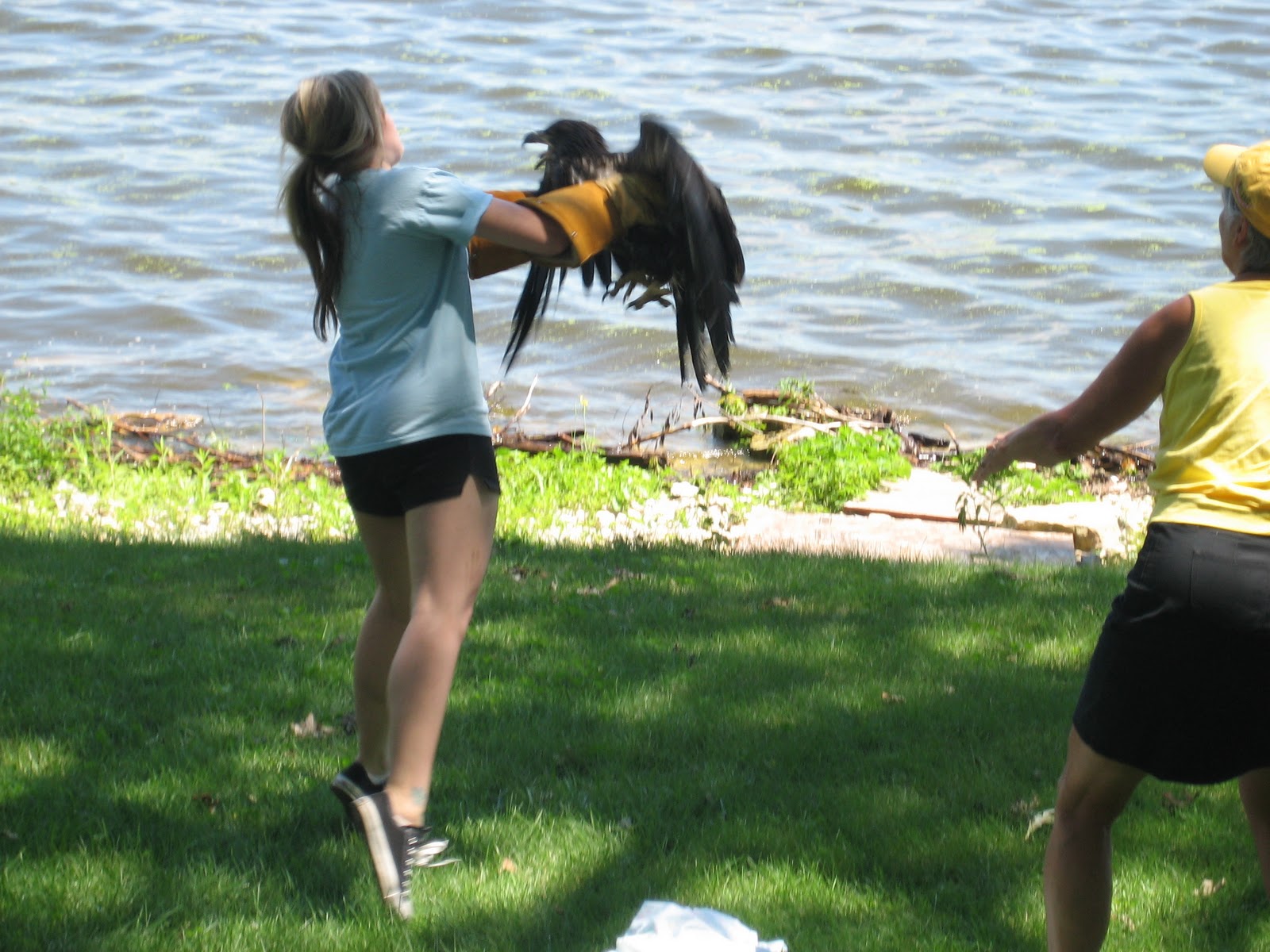
Rehabbers from the Center the Eagle was transferred to and cared for at release it back to its home territory while Rick photographed the moment he had been hoping to see since he first rescued the bird.

Wednesday, October 27, 2010

To trap or not to trap, that is the question

A phone call I received today was a rather unique one. The woman had gone to her basement door last night to see what her dog was getting excited about and when she opened it a small creature streaked past her and into the basement. At some point this morning he had found his way upstairs and into a bathroom which is where she trapped it as she made her phone call for advice.

Normally we don’t recommend using the “answer to every problem” live-trap to solve conflicts between people and their wild neighbors. This situation proved difficult however, as the animal was clearly hiding in a room far from the nearest outdoor exit in a house with 2 large dogs.

We determined that the wayward creature was likely a weasel. The plan was to locate a very small live-trap baited with canned cat food and place it in the closed room. In these situations we always advise homeowners to do their best to locate the point of entry and close it if they can (in this case it was a coincidence involving a door so it was an easy solution) and then release the animal to a safe corner of their property. We’ll come back to this story in a moment.

The next call I received was from a woman who had a Virginia Opossum in a live-trap. She had successfully trapped and “relocated” 3 in the past week and wondered if there was something less time-consuming that could relieve her of the midnight garbage raiders. Our conversation was a helpful one; I explained to her that not only was relocating these animals a lot of work for her, but it was also not the best solution – nor legal! After our discussion, she had a number of recommendations that she was going to set out to implement. Because the animals were getting into the trash, other than putting straps, locks or bungee cords on the container, one option was for her to contact her waste disposal company to find out if she could exchange her current receptacle for a clean, new one that didn’t have such a strong odor, or barring that, taking the time to thoroughly clean the one she was using. She was also going to try leaving the lights on in the area the receptacles were kept to force any potential raiders to commit their crimes in the light. Because she was not providing any other food sources (neither her nor her immediate neighbors were feeding birds or other pets outdoors) these few tactics should do the trick.

Opossums are by nature nomadic and they generally only stay in one area if they consistently find food there. They are not picky when it comes to food, but if they can’t find enough they will move on to other areas where they can. Keeping up food and implementing small things that change the landscape that animals are used to or startle them when they least expect it are often all it takes to solve conflicts in a humane manner. Even if being humane isn’t your top priority (why are you reading this blog then?), the safety, hassle and legality of trapping and relocating animals should be.

The second woman thanked me for all of the information and I think that she will have a much better week now. Back to the first caller. Shortly after we talked she had gone to the bathroom to check on the status of her uninvited guest and brought with her a heavy bag and a piece of bologna. When she opened the door he was peering around a corner at her so she instinctively tossed the bologna into the bag and held it in the doorway in front of her. Surprisingly, he was hungry enough to be fooled with her behind the door and voluntarily walked right into the bag to enjoy his feast. She was able to safely bring him to the long grassy area in the back of her property and release him back to his home and duty of controlling the rodent population there.

Two different traps, two different reasons, and at least two happy endings. If you have a friend or a neighbor experiencing conflicts with their wild neighbors and considering using a trap to solve them, suggest that they give their nearest wildlife rehabilitator a call for advise that may be better for both them and the animals.

Wednesday, September 15, 2010

A free bird again

It’s always wonderful to see a happy ending to a story, especially when you get to be there for both the beginning and the end! Working as a phone counselor, admissions receptionist and visitor greeter, as well as development and marketing coordinator for the Wildlife In Need Center, I don’t often get to make a connection with any one patient that comes through our doors. Well, I did try to raise those orphaned white-footed mice, but we’ll save that story for another time.

I received a call early on a Thursday morning near the end of August from a business owner. He had rescued a Great Horned owl found with its leg caught on a piece of equipment. Upon arrival it seemed like the bird was in terrible shape, but a thorough examination revealed that, although dehydrated from the struggle, his injuries appeared to be primarily external.

We kept him calm for several days, treating the wounds and consulting with our volunteer veterinarians. It was confirmed that he had no fracture so it would just be a matter of time before he was healed and ready to go back home!

After 2 weeks of therapy and treatment his leg was looking much better and he was prepared to return home. The area where he had been found was a short way south of where I live so I was asked if I’d be willing to assist. So, after shutting down the office for the evening I watched as he was packed into a kennel cab for the ride. I drove home quietly and when I got there left him to rest quietly in the garage while we waited for the sun to go down.

After dinner my husband and I got in the car and headed out. We found the location easily and, since it was beginning to get dark, we pulled in with our headlights shining on the area we wanted to release him. Once we were set up I stood behind the kennel and opened the door. He hesitated for a moment as Andy was set-up to photograph the event and he could see him out of the corner of the doorway. Once he inched back a couple of inches however, the owl regained his bravery and came storming out!

The one shot of the event that turned out was this moment; the rest of his adventure was a graceful arch up and out, heading to the west and into a thicket of trees. One aspect of assisting on releases is that you get to talk to people. I talk to a lot of people during the day with questions regarding their wild neighbors and the center, but when you speak to someone during a special event like this it’s different. Before we could hop back in our cars to bid our owl friend a final adieu a vehicle stopped to find out if we needed any help. Once we explained what we were doing the passerby gladly took some information about the Center and said she was definitely going to contact us about volunteering. IF she joins us, hopefully we’ll be able to have even more happy endings.

Sunday, July 4, 2010

A Special “Independence Day” Update


Lonesome Louise is lonesome no more!
I don’t know what a southern squirrel will think of northern winters, but Louise certainly has a beautiful place to live. On Thursday, June 24, she and her two buddies were released at a gorgeous several hundred acre farm near Dousman. The owners have multiple bird and squirrel feeders as well as nest boxes and huge oak trees all around their house. When we opened the door of Louise’s nestbox, she was the first to come bounding out, bouncing in huge leaps across the yard. It was probably the first time she ever had grass beneath her feet. She ran across the yard – there was no cage wall to stop her anymore. Then she dashed into the open door of a small shed. “Oh, that’s where we store the corn and sunflower seed. She knows where to go!” Liane laughed. Louise’s two buddies were a little shyer and we had to remove the roof of the box to get them out. By that time Louise had ventured out of the building and was discovering that the trees had no roof; imagine that!

Thanks to all of our generous home and property owners we can give our orphaned patients a good start to life by releasing them in areas where they will be able to find the resources they need to live long, happy lives. To find out more about becoming a release site, visit our website at: http://www.helpingwildlife.org/getinvolved/volunteer.htm#release

Wednesday, March 31, 2010

A Happy Ending

The evening of Tues, March 10th I received a phone call at home from Department of Natural Resources Game Warden Dave Walz. I live in Jefferson County and have often met Dave to pick up injured animals to bring to the Center. Dave had rescued an owl that had been tangled in netting at a game bird farm near Ashippun.


He had cut the owl free but didn’t know how long it had been struggling or how severely it was injured. Since it was late, we made arrangements for him to let the owl rest overnight with him and then he dropped it by my house early the next morning for me to bring to the Center. The next morning I discovered it was a small male Great Horned Owl and that he was pretty grouchy about being in captivity.


Upon examination, Animal Care staff discovered minor abrasions and a sprained leg and wing from struggling while tangled in the netting. We wanted to give him a couple days to recover, but we were also concerned to get him released to origin as soon as possible.


Why would we send him back to the area where his injuries had occurred? First of all, raptors are territorial and that was his territory. Also, if he had a mate, she would be sitting on their babies to keep them warm. As the male in the family, he would be expected to do most of the hunting for her and the babies in addition to himself. While he was here we had several warm nights so hopefully mom could safely leave the babies for a short while to hunt.


On Sunday, March 14th after work, I drove Mr. Great Horned (as we lovingly referred to this stout little guy during his stay) back home. There was a long gravel driveway to a ridge that dropped away towards the property where I parked my vehicle. He was footing (grabbing with his talons) the door in his excitement by this time. I opened the door, he took one hop onto the road, then threw out his wings and flung himself into the air.


He soared off the ridge, down over the valley, past a pond and landed in a tree to get his bearings. It was so beautiful to see him fly off into the sunset. I hope he got back to his mate in time to help care for his young - Although I do wonder just how he will explain his absence of several nights to his mate. “Really, honey, I was hunting for mice and this stuff grabbed me. And then these aliens abducted me and took me somewhere and performed medical procedures on me…”


Guest Blogger LR
Here's a sneak peak at someone you'll be hearing about in the next couple of weeks... stay tuned

Thursday, March 18, 2010

Parting is Such Sweet Sorrow


And so it was sweet sorrow for the staff and volunteers of the Wildlife in Need Center, as Romeo and Juliet, the Barred Owls were released on Sunday, March 14th, after twenty-nine days of hydration, weight gain and flight therapy. A small crowd gathered in Menomonee Falls, as staff, volunteers, neighbors and the homeowners witnessed the owl’s flight to freedom. The release was set for 6:00 p.m., a time when the impending dusk would allow for better camouflaging should there be any potential predators. As the star crossed lovers were released, Romeo flew onto a nearby tree branch, checked his bearings a glided silently out of sight. Juliet though, much to everyone’s surprise, landed on a nearby chimney similar to the one from which she’d been rescued. Juliet’s stay was thankfully brief, when with a great beat of her wings she was off and flying through the densely wooded lot. I quickly scanned the trees, locating her perched in a distant tree. Through my camera lens I could still see her dark haunting eyes. She stopped in the tree only long enough to take one last look at her captors, as if to say in her silent stare, “Thank you”, then she was gone.


Good-night, good-night! Parting is such sweet sorrow
That I shall say good-night till it be morrow.
-Juliet, Act II, scene ii
Guest Blogger -KF