Wednesday, August 3, 2011

Miracles Happen Everyday

Well actually a "Miracle" (having the Wildlife In Need Center and our children's environmental education project funded) did not happen today. However, each day a wild animal makes it through our doors, or is set free after rehabilitation, a new volunteer gains experience and insight they couldn't get anywhere else, or a child's world is changed forever by meeting our educational ambassador, Dakota, the Great Horned Owl - we consider that a miracle.

While I do wish I were writing to tell you all that we had just been chosen as one of Potawatomi Bingo Casino’s Miracle Charities for 2011, and the amazing things we’d hoped to do with the opportunity, that's not the case for this year. We do however, have a number of interesting and exciting projects in the works that I wanted to tell you about.

You should already know about our various volunteer programs, outreach programs, and of course our focus on continuing to provide the best rehabilitation to our wild neighbors possible. I thought you might be interested in a few other projects that we’re working on which you may not have heard about until now.

Did you know that an important segment of WINC’s mission from the beginning has been to provide education to the public for the benefit of our wild neighbors? In addition to providing answers via phone, website, and other means (like our blog!), for nearly a decade we’ve offered environmental education programs featuring our ambassador animals on an outreach basis through as many as 120 outreach programs a year! Now that supporters like you have helped us reach new heights with the completion of our new facility we hope your generosity will continue to help us soar even higher with these unique education-focused projects.
  1. One project WINC is collaborating on is focused on connecting children and wildlife through learning. This project involves long-time supporter, Rebecca Seymour, and children’s author and President of The Little Environmentalists, Rebecca Mattano, as well as staff and volunteers of WINC. Our team is creating a book featuring the educational animal ambassadors that can be used in conjunction with as well as independently of the general educational programming we’re already providing.
When used during one of our programs, children of all ages, from tots to seniors, will have the chance to revisit the experience that they had meeting Dakota, Waldo, and even Daphne, in this book that will remain with their classroom or activity coordinator. Those who, for whatever reason, don’t have the option of a live program could request several copies of this book through which any educator could offer a unique experience on its own to their students.

These books would also be available to anyone visiting the new WINC facility, whether simply to browse through or to purchase to take home and use to educate their own friends and family. The total budget for this project is $10,000. Donated time from both Rebecca Seymour and Rebecca Mattano, funds from sales at The Little Environmentalists, as well as a $1,000 grant already received from the Greater Oconomowoc Area Foundation have helped to bring the amount we still need before going to print to $6,500. Once the books are printed, funds from any sold here in our office will be saved to pay for future printings.

Are you interested in finding our more about this program? Are you a professional designer or editor interested in joining our team, or do you work for a publishing company that might be interested in helping us make this dream project a true reality? Perhaps you’re just interested in making a small contribution to help us get to our goal? If so, please contact us today!

Stay tuned to future posts for more unique projects you may not know about going on at WINC that you can get involved with!

Wednesday, July 27, 2011

New Nest, Same Story

So you think you’ve found a baby bird…


photo by LMB
The first question to ask is this really a baby bird or is it a small adult bird?

The second question is what was the bird doing before you discovered it and what has it been doing since? Also note whether or not any injuries are obvious.

It may seem like baby birds are a product of spring, but here in Wisconsin we have several species of songbirds that nest later in the season and also some that nest several times throughout the season. Just because it’s July doesn’t mean baby bird season has stopped here at the Wildlife In Need Center!

So, what do you do now that you’ve found a baby bird?

Baby birds that still have lots of pink skin showing and whose feathers are soft and fuzzy or nonexistent are called nestlings. Nestlings are babies that should be in the nest but may fall out due to weather, predators, or other forces. Baby birds that don’t have any obvious injuries should first be warmed up to body temperature under a lamp, on a heating pad, or in your hand before being renested. Those that can be replaced in their original nest should be. In cases where the nest has been destroyed or is too high to reach the baby can be replaced in a substitute nest. A substitute nest can be made of a wicker basket, hanging plant basket or any plastic container with drainage holes poked into it. If using a plastic container be sure to line it with dried grasses, sticks or leaves so that it isn’t slippery. Hang your substitute nest at least 4-6 feet off the ground so it is out of easy reach of neighborhood pets and kids and within hearing distance (less than 12 feet) of the original nest. Don’t feed the baby; it should be hungry and peep because of it – that noise alerts the parents to where it is and they will feed it as well as any siblings in the nest.

Fledglings are babies that are old enough to leave the nest. They spend a couple of days hopping around the ground and making buzz flights an inch or two above the ground a foot or two at a time. That is how they learn to fly and build up their strength; activities they can’t do in a nest. Their parents continue to feed them on the ground but don’t stay with the baby at all times. Fledglings are mostly feathered, with wing feathers and at least a start of tail feathers, but may still have a bit of baby fluff here and there. Babies at this stage should be left alone and monitored from a distance.

If you have any further questions or you feel that the baby bird you’ve found may be injured please contact your nearest wildlife rehabilitator as soon as possible.

Thursday, July 14, 2011

Grand Opening Ceremony!

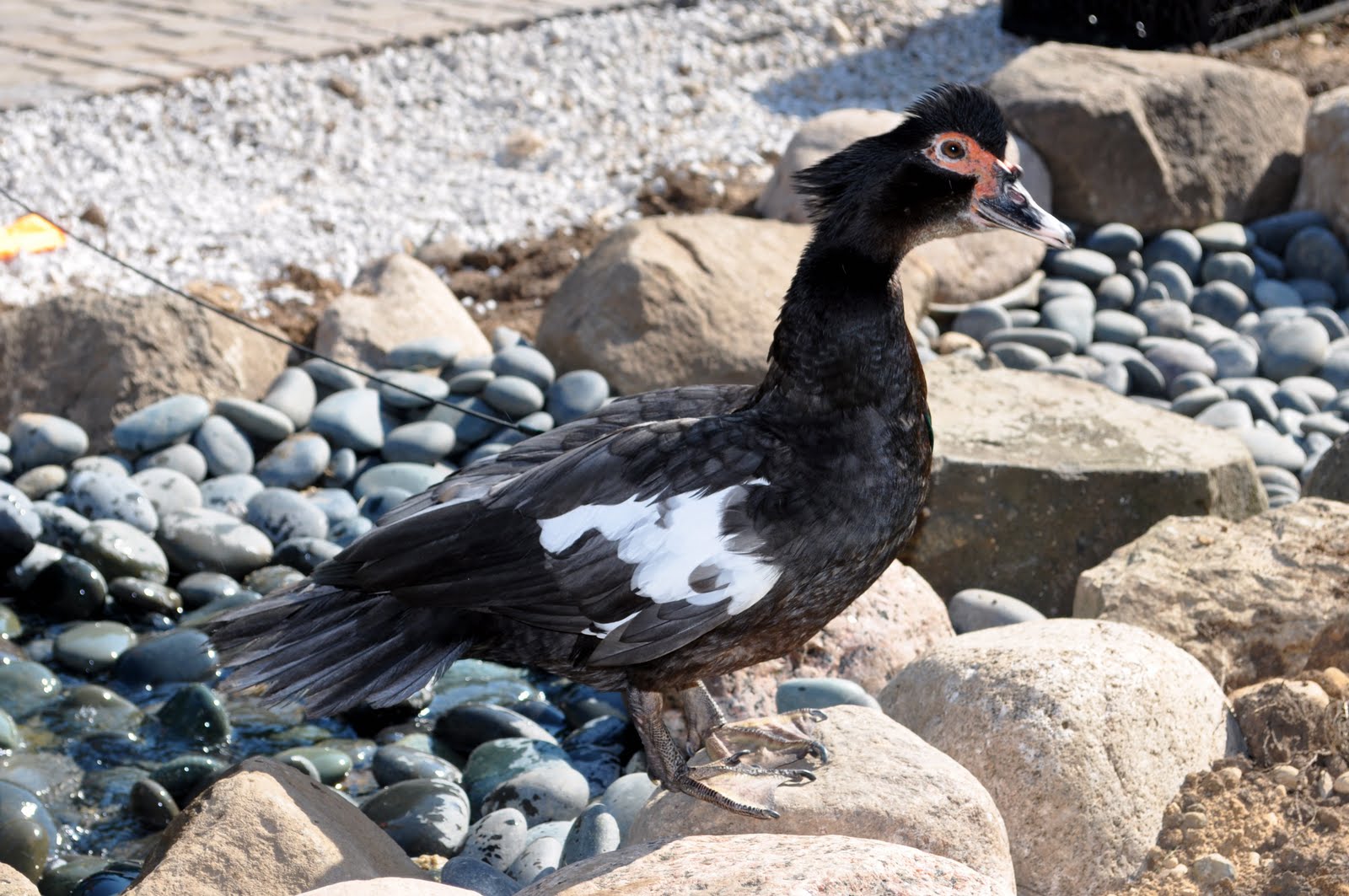
Last week on Thursday, July 7, 2011, we held our official Grand Opening Ceremony for special supporters who made the new building possible.  At the Grand Opening, the board of directors and their families, along with other guests were able to get a walk through tour of the new center.  Two of our Animal Ambassadors were around for the excitement at the Grand Opening. Guests were greeted by Daphne, the Muscovy duck, who was playing in the water feature right outside the front of the new center.

Daphne playing in the water feature and greeting guests.
This exclusive water feature is part of the filtration for a water conservation system enabling the center to reuse water for cleaning and filling ponds.  As guests entered the gathering area, they saw Dakota, the Great Horned Owl with Leslie Kiehl, our education coordinator.  When it was time for the ribbon cutting ceremony, members of the board of directors, UWW’s Marlin Johnson, and County Executive Dan Vrakas shared short speeches on how we have grown over the years.

Guests listening on to the speakers during the ceremony.

  The ribbon was cut with a pair of garden sheers, fitting for our new center.  At the end of the evening, Wildlife Rehabilitators, Cheryl Diehl and Chelsea Matson brought outside a Male Eastern Red Phase Screech Owl to be released.  The release of the owl was great way to symbolize that the center is soaring to great heights of continuing to bring rehabilitation to wildlife. 

Standing in front of the new building ready to cut the ribbon.
We will be hosting public open houses at the new center on Saturday August 27th and Sunday September 11th, 2011 from 1 p.m. – 3 p.m. These will include tours of the new facility led by our volunteers. Additionally, the new center is family friendly, educational, and fun for everyone anytime during office hours.

Guest Blogger: JH